

Engineered for extremes
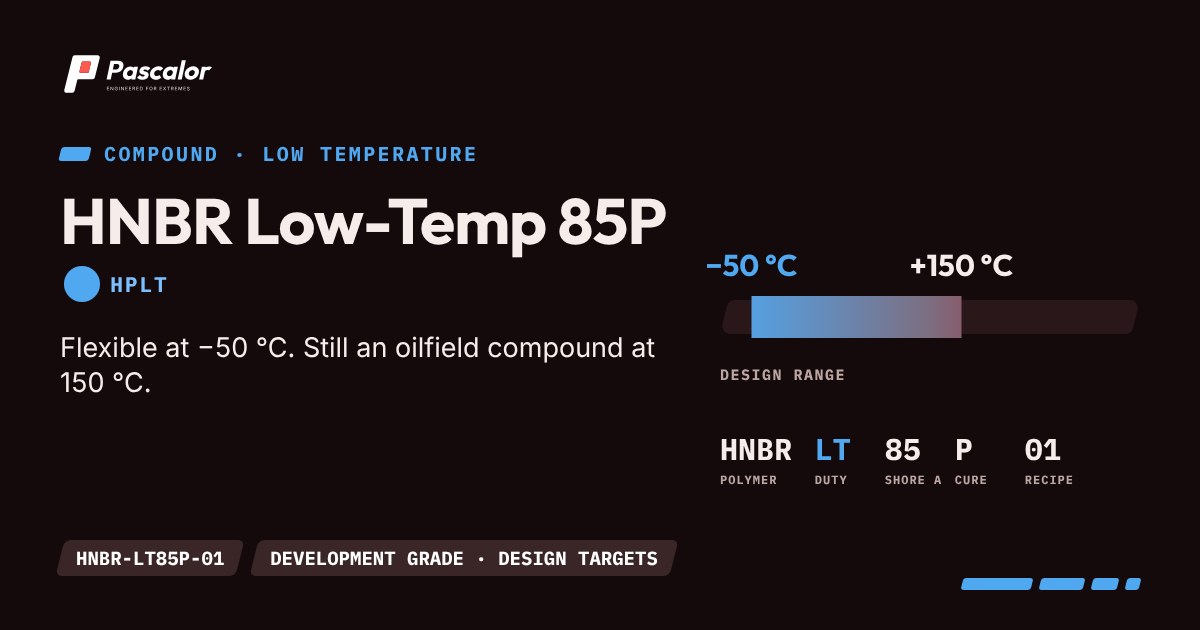
HNBR Low-Temp 85P
Read the code: HNBR, LT duty (low temperature, seals at −40 °C or below), 85 Shore A, P for peroxide cure, recipe 01.
Development grade. The values below are design targets, not measured results. Each target becomes a typical value, with the number of lots and the test report behind it, as testing is completed.
An 85 Shore A low-temperature HNBR for HPLT service: sealing at −50 °C under pressure, with RGD resistance and the mechanical strength of HNBR. The lower acrylonitrile content buys cold flexibility at some cost in oil swell, which the datasheet states.
- Polymer class
- HNBR
- Duty
- LT: low temperature, seals at −40 °C or below
- Pole mark
- HPLT
- Hardness
- 85 Shore A
- Temperature range
- -50 to 150 °C
- Lead time
- Trial quantities on request
- Minimum order
- 25 kg
- Issued
- 2026-10-28
- Revision
- A
- Packing
- Per order
Design targets and release limits
| Property | Target | Limits | Unit | Method |
|---|---|---|---|---|
| Hardness | 85 | 80 to 90 | Shore A | ASTM D2240 / ISO 48-4, 1 s |
| Specific gravity | 1.2 | ±0.02 of approved value | ASTM D297 / ISO 2781 | |
| Tensile strength | 20 | min 16 | MPa | ASTM D412 die C / ISO 37 type 2 |
| Elongation at break | 200 | min 150 | % | ASTM D412 die C / ISO 37 type 2 |
| Modulus at 100 % | 8 | 6 to 10 | MPa | ASTM D412 die C / ISO 37 type 2 |
| Compression set, 22 h at 150 °C | 22 | max 30 | % | ASTM D395 method B, button |
| TR10 | -38 | max -35 | °C | ASTM D1329 / ISO 2921 |
| Low-temperature sealing (product test) | -50 | no leak at −50 | °C | Product-configured O-ring test at pressure |
| Heat ageing 70 h at 150 °C, hardness change | +4 | 0 to 7 | points | ASTM D573 / ISO 188 |
| IRM 903, 168 h at 150 °C, volume change | +15 | max 25 | % | ASTM D471 / ISO 1817 |
Qualification plan
The grade code says what this compound is designed for. This table says what it has passed: a duty is claimed only once its report is on file.
| Test | Standard or method | Conditions | Status |
|---|---|---|---|
| Rapid gas decompression | ISO 23936-2 Annex B / NORSOK M-710 | 90/10 CH4/CO2, 15 MPa, 100 °C, 8 cycles, about 2 MPa/min decompression; 5.33 mm and 6.99 mm sections; target rating 0000 to 1111 (0 to 3 passes) | Planned |
| Sour ageing and life prediction | ISO 23936-2 Annex A / NORSOK M-710 | Sour multiphase fluid (hydrocarbon liquid, water, gas with H2S) at three temperatures; Arrhenius extrapolation to service temperature | Planned |
| Elastomer immersion | API 6A Annex F, material class FF/HH | 10 % H2S / 80 % CO2 / 10 % CH4 gas phase, at least 6.9 MPa, at least 160 h at 149 °C; NORSOK-style acceptance limits | Planned |
| Low-temperature sealing | Product-configured O-ring test (method published with the report) | Sealing at −50 °C at rated pressure; leak onset temperature reported with TR10 of the same lot | Planned |
| Product low-temperature cycle | API 6A PR2 (with an OEM, on its seal design) | Temperature class L or K cycle on the customer's product | Planned |
Design targets are the values the compound is designed to reach. They are not measured results and they are not a warranty. Release limits apply to lots once the recipe is approved. The grade code says what the compound is designed for; the qualification plan says what it has passed. Confirm suitability in your own application and fluids.
Every lot is supplied with a certificate of analysis. Enter the lot ID under Track on the website to see the lot record. Pascalor is an independent brand and is not affiliated with any polymer manufacturer named elsewhere on this site.
Registered entity name to be added | quotes@pascalor.com