

Insights
White papers and insights
White papers, technical blogs and field notes on elastomer compounding, mixing and sealing in extreme heat and extreme cold.
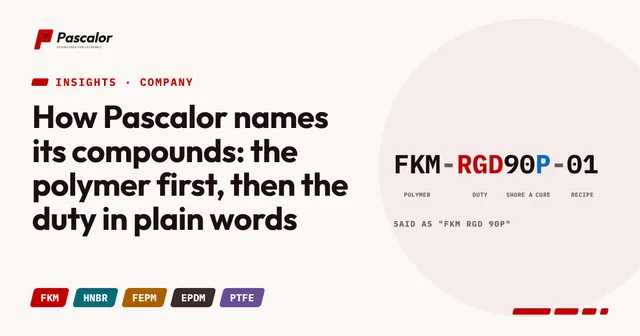
How Pascalor names its compounds: the polymer first, then the duty in plain words
A grade name should tell you what you are buying, and nothing in it should belong to anyone else. Ours is the polymer, the duty in plain words, the hardness, the cure and the recipe: FKM-RGD90P-01 is said FKM RGD 90P.
Read →
What a lot record should tell you before you accept a batch
A certificate with one hardness value is not a quality system. This note lists what a useful lot record shows and how to read it.
Read →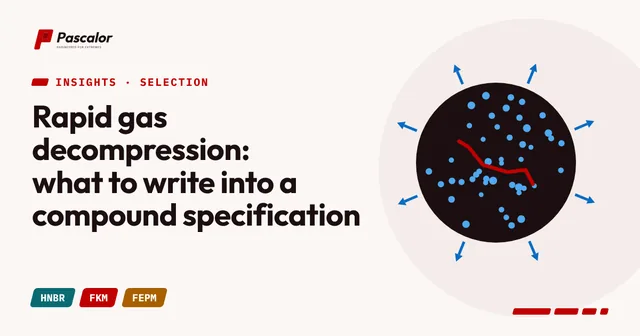
Rapid gas decompression: what to write into a compound specification
Rapid gas decompression (RGD) damages elastomers that were fine in static immersion. This note lists what to specify so suppliers can propose and prove a suitable compound.
Read →
Low-temperature FKM: the options and what to ask a supplier
Standard FKM stiffens in the cold. Here is how low-temperature FKM is built, what the cold-end numbers mean, and the questions that reveal whether a grade will seal when it matters.
Read →
How to write a compound specification that gets comparable quotes
Vague requests get vague quotes. Here is the short list of facts, limits and test methods that lets a supplier propose the right compound and lets you compare the answers.
Read →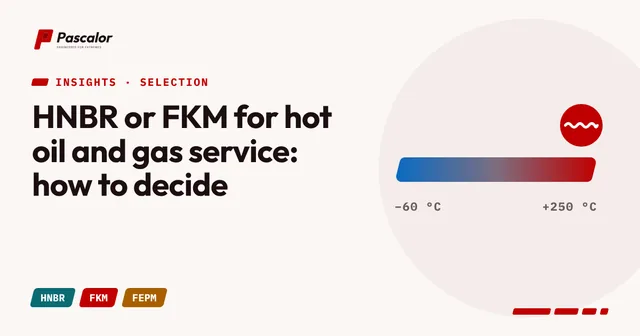
HNBR or FKM for hot oil and gas service: how to decide
A practical way to choose between HNBR and FKM for hot, chemically aggressive duty, starting from the fluid and the temperature window rather than from habit.
Read →
Custom or off-the-shelf compound: when each makes sense
A standard grade is faster and cheaper to qualify. A custom compound is worth it when the duty falls between grades. Here is how to tell which side you are on.
Read →
Why HPLT is its own discipline: pressure plus cold is not just HPHT in reverse
Seals that must work cold and under pressure fail in different ways from seals that must work hot. Why we treat high-pressure, low-temperature service as a separate specialty.
Read →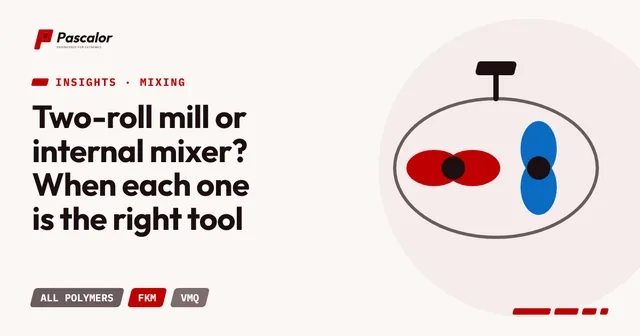
Two-roll mill or internal mixer? When each one is the right tool
The open mill is slow, flexible and gentle on temperature. The internal mixer is fast, enclosed and strong. Which to use for development, small batches, curative addition and silicone.
Read →
Tangential or intermeshing rotors? Choosing an internal mixer for the compound you make
The two internal mixer families behave differently in temperature control, dispersion and flexibility. A decision guide for specialty elastomer compounds.
Read →
Mixing sequences: conventional, upside-down, masterbatch and Y-mixing explained
The order in which ingredients meet decides dispersion, scorch safety and oil take-up. When to use each method and what to watch.
Read →
Mixing for HPLT: what changes when the compound has to stay flexible in the cold
Low-temperature compounds depend on low-Tg polymers, careful plasticiser use and a network that is neither too tight nor too loose. How mixing choices protect those features.
Read →
Mixing fluoroelastomer (FKM) compounds: stiff gum, cool dumps and clean equipment
What changes when the polymer is a fluoroelastomer: gum viscosity, curative-incorporated grades, metal oxide handling, temperature limits and why cleanliness is part of the recipe.
Read →
Mixing HNBR and FEPM with peroxide: managing viscosity and scorch together
Peroxide-cured elastomers combine stiff polymers with a short scorch window. A two-stage approach, temperature limits and coagent handling that keep compounds consistent.
Read →
Internal mixing (intermix) technology for elastomer compounds: a practical white paper
How an internal mixer works, what each machine variable does, how a mixing cycle is built and controlled, and what changes when the compound is a fluoroelastomer, HNBR or a low-temperature grade.
Read →
From lab mixer to production mixer: scaling a compound without losing its properties
A compound that works in a small laboratory mixer may behave differently in a production mixer. What changes with scale, and a method for scaling by energy and temperature rather than by time.
Read →
Dispersion and batch quality control: what to measure after every mix
A practical set of tests that tell you whether a batch is good: Mooney, rheometer, density, dispersion rating and the Payne effect, with how to chart them and when to act.
Read →
Designing an internal mixing cycle: fill factor, ram pressure, speed and the dump criterion
How to set the variables of a mixing cycle, in what order to change them, and why the dump criterion decides batch consistency more than any other setting.
Read →Nothing matches that search.