How packing works
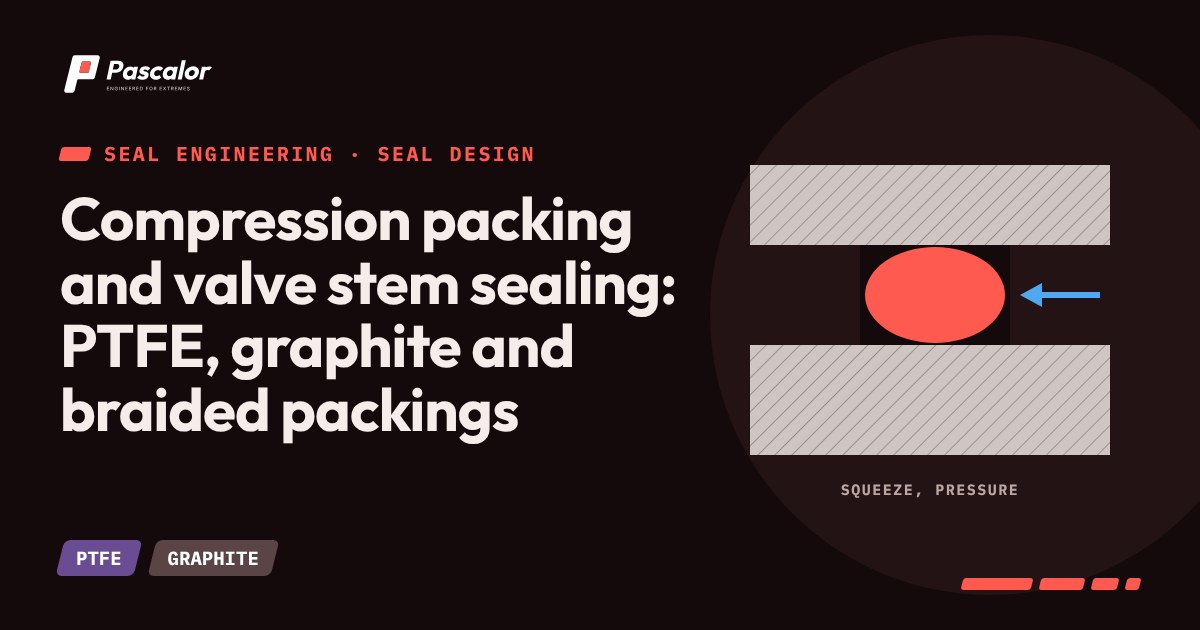
Rings of braided or moulded material sit in a stuffing box. A gland follower compresses them axially so they bulge radially against stem and bore. Adjusting the gland load controls leakage and friction.
Materials
| Packing | Strengths | Limits |
|---|---|---|
| PTFE (braided or moulded) | Chemical resistance, low friction | Creep, limited temperature, cold flow |
| Graphite (flexible, expanded) | Very high temperature (to 450 degrees C in air, higher in steam or inert), fire-safe | Galvanic corrosion with some metals, brittle |
| Aramid, carbon fibre | Strength, wear resistance | Abrasive to stem, need lubrication |
| Elastomer-core or live-loaded sets | Constant load | Complex |
| Mixed sets | PTFE rings with graphite end rings | Design needed |
Stem requirements
Hard, smooth stem (Ra about 0.2 micrometres), corrosion resistant, concentric, with minimal side load. Bores and gland chamfers should be correct.
Emissions
Fugitive emission regulations (for example ISO 15848-1, API 624 and API 622, TA Luft) set low leak rates for valves. Qualified packings and live-loading (Belleville springs on the gland studs) are used to achieve them.
Gland load
Too low leaks. Too high wears the stem and increases friction. Start with the maker's value, adjust gradually after thermal cycle, and do not add more rings than the stuffing box allows. Re-tightening is part of maintenance.
Common problems
- Packing run dry, which burns or glazes.
- Wrong ring sequence in the stuffing box.
- Stem corrosion or scratches.
- Cold flow after thermal cycles.
- Using graphite with stainless stem in wet service without corrosion inhibitors (galvanic cell).
When to use something else
Spring-energised PTFE seals, bellows seals or mechanical seals when emission limits are strict, or when maintenance access is poor.