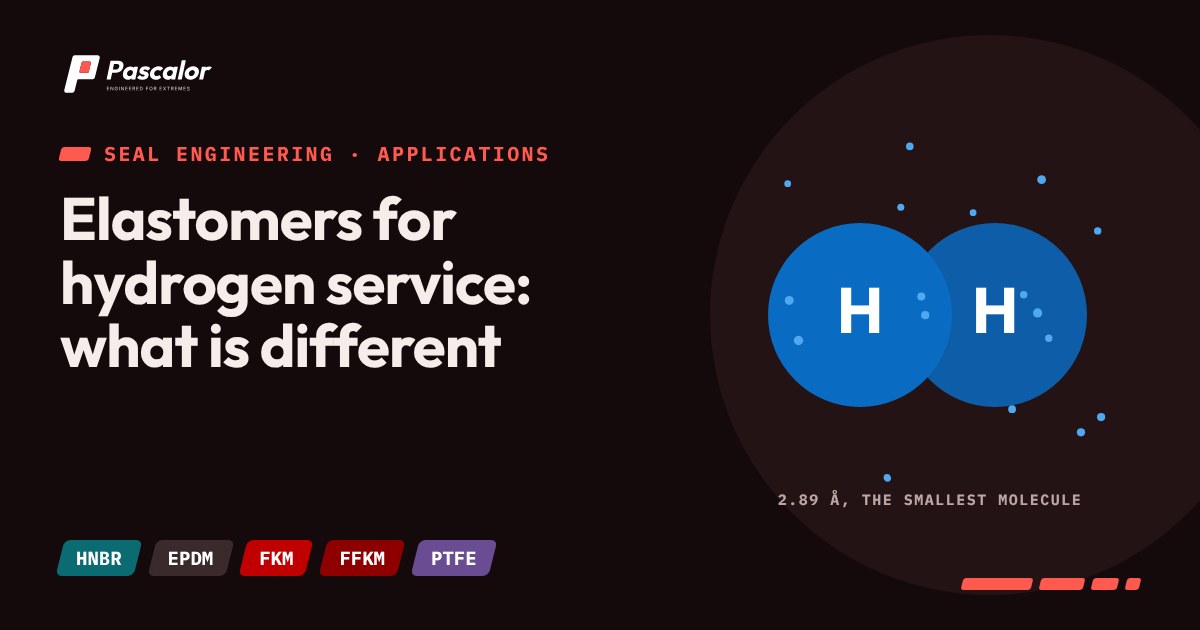
Hydrogen is the smallest molecule. It dissolves in and diffuses through rubber faster than most gases. Systems also run at high pressure and often cold, so decompression and low-temperature behaviour matter.
Challenges
- Permeation of hydrogen through elastomer and plastic.
- Rapid gas decompression at pressure drops from 35 to 70 MPa (dispensers) or more.
- Low temperature during fast fill (down to -40 degrees C) and in liquid hydrogen service (-253 degrees C).
- Fillers and additives: some can react with or lose properties in hydrogen; plasticiser extraction by dry gas.
- Tribology: hydrogen gives little lubrication, so friction and wear rise.
- Embrittlement of mating metals, which affects the seal gland rather than the seal.
Material notes
| Material | Hydrogen notes |
|---|---|
| HNBR, filled | Common in dispensers, good RGD resistance if properly formulated |
| EPDM (peroxide) | Used for gaseous service with good low temperature, check for swell |
| FKM | Reasonable permeation resistance; low-temperature grades needed |
| FFKM | Used in difficult cases; high cost |
| PTFE, PEEK | Common as back-up and sliding seals, permeation to be checked |
| Silicone | High permeation, rarely used |
Qualification
Standards under development or in use include ISO 19880 series for fuelling stations, SAE J2579 for vehicles, and ISO 11114 for compatibility of materials with gas. Test items include exposure to hydrogen at temperature and pressure, RGD cycling, permeation measurement and low-temperature function.
Design hints
- Use hard compounds (85 to 95 Shore A) and back-ups for high-pressure static seals.
- Keep groove fill low enough to allow swell without extrusion.
- Provide venting and slow decompression where possible.
- Avoid sharp-edged hardware; gas bubbles tear rubber.
- Keep traceability by batch because hydrogen qualification is compound-specific.
Outlook
Hydrogen is a growth market for seals that reliably survive decompression and cold. Qualification data is the entry ticket; compound names alone do not qualify a product.
About this article. It is original writing prepared from public sources, standards and general industry practice. It is not a copy of any book or standard and it is not engineering advice. Confirm values against the current edition of the standard and test in your own application. Only analyse material you own or are entitled to analyse.