The bonded system
Metal (steel, stainless, aluminium) is cleaned and roughened, coated with a primer and a cover adhesive, then the unvulcanised rubber is moulded onto it. During cure, chemistry in the adhesive bonds to the rubber and to the metal.
Steps in good bonding
- Degrease. Remove oil and drawing compounds.
- Blast or etch. Grit-blast (or phosphate) for roughness and fresh surface.
- Prime and cover coat. Apply each to controlled thickness and dry time.
- Mould. Handle with clean gloves; avoid fingerprints and release agent.
- Post-cure as the rubber requires.
Adhesive families
Adhesive systems are matched to the polymer: separate systems exist for NR, NBR/HNBR, EPDM, FKM and silicone. Use the maker's recommended pairing and bake schedule. FKM bonding often needs a special cover coat and a long post-cure.
Test methods
| Test | Standard | What it shows |
|---|---|---|
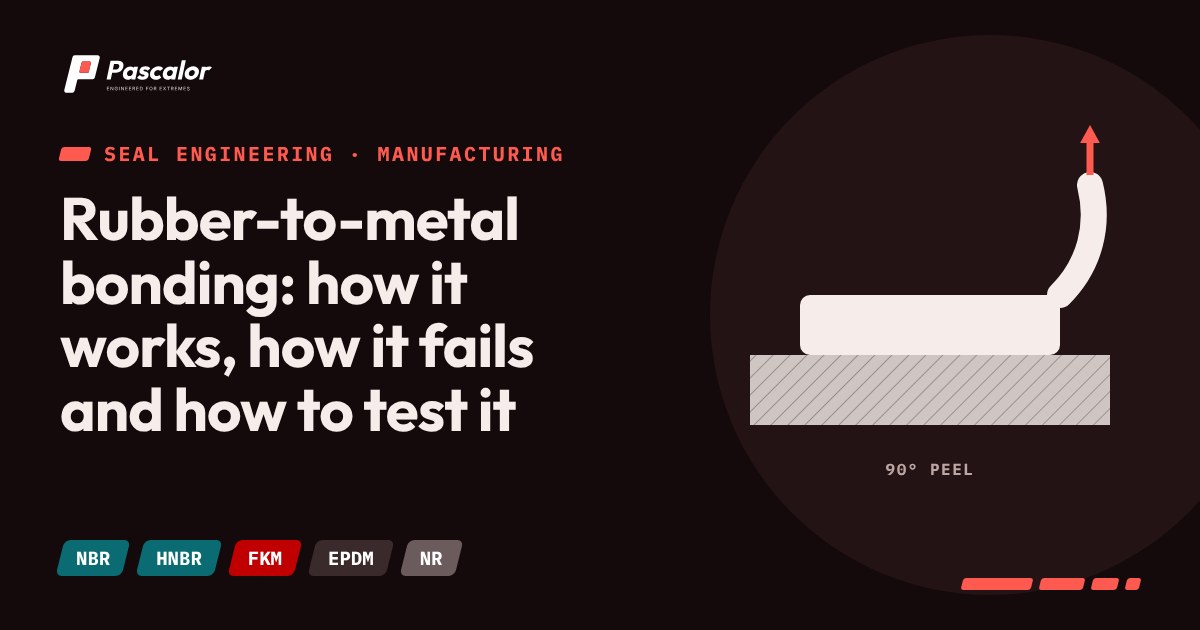
| 90-degree peel | ASTM D429 Method B, ISO 813 | Adhesion strength, mode of failure |
| 45-degree stripping | ISO 813 | Adhesion in parts with different geometry |
| Tension | ASTM D429 Method A | Bond under pull |
| Shear | ISO 1827 | Bond under shear |
| Salt spray, fluid ageing | ASTM B117 and customer | Durability |
Report the failure mode: percentage rubber tear (R), adhesive-to-rubber (RC), primer-to-cover (CP) or metal-to-primer (M). A good bond tears the rubber (R) rather than the interface.
Typical failure causes
- Contaminated or poorly prepared metal.
- Over-aged adhesive or wrong storage of coated parts.
- Mould release in the wrong place.
- Poor cure or too short post-cure.
- Fluid attack at the exposed bond line (corrosion creep).
- Rubber compound change without bond re-approval.
Design rules
- Round all metal edges.
- Avoid very thin rubber layers over large metal areas.
- Allow rubber to bulge: keep the free surface, because rubber is almost incompressible.
- Provide venting for trapped air and an overflow groove.
- Seal the exposed bond edge with rubber where fluids can attack.
Quality plan
First-article peel test, batch peel samples, adhesive lot control, and traceability to the metal supplier and the heat treatment. Re-test whenever the compound or adhesive changes.