| Seal | Profile | Strengths | Limits | Typical use |
|---|---|---|---|---|
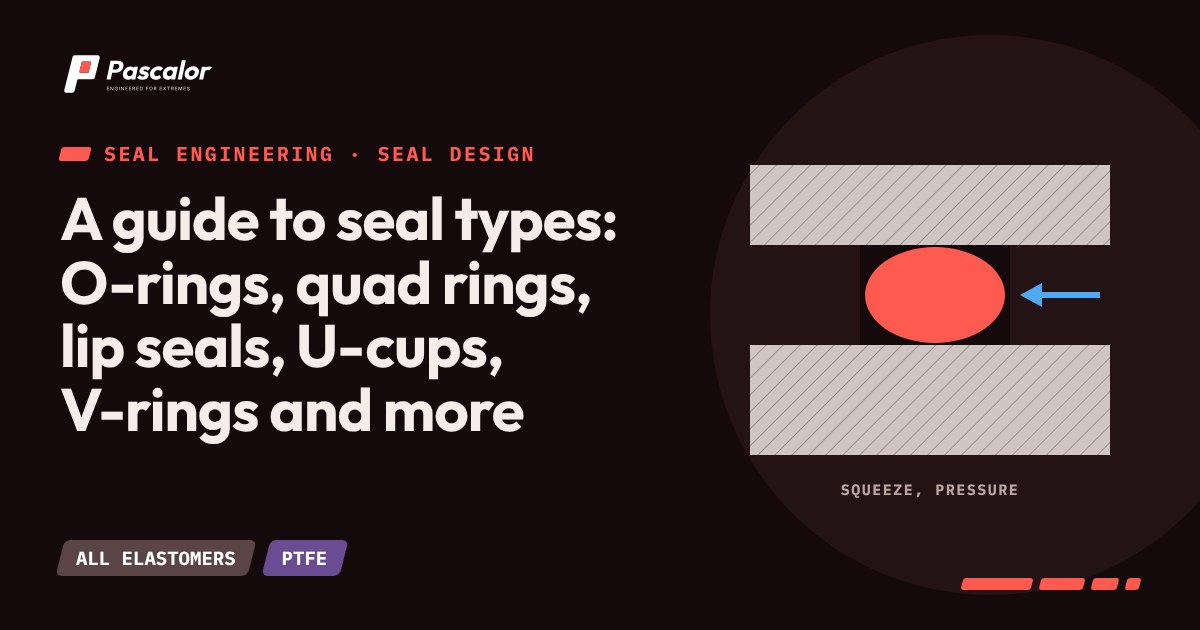
| O-ring | Round torus | Cheap, simple, static and light dynamic | Spiral twist, limited speed | Everywhere |
| Quad ring (X-ring) | Four-lobe | Two sealing lines, less twisting, lower friction | Needs matched groove | Dynamic reciprocating |
| U-cup, rod seal | U-section lip | Pressure assisted, low friction | Single direction | Hydraulic cylinders |
| Piston seal (cap seal) | PTFE cap over energiser | Low friction, high speed | Higher cost | Hydraulics, pneumatics |
| Lip seal (radial shaft seal) | Lip on spring | Rotary shaft, grease/oil retention | Low pressure | Gearboxes, pumps |
| V-ring | Axial V lip | Excludes dirt, runs on a shaft | No pressure sealing | Bearings |
| Wiper (scraper) | Lip | Cleans rod on retraction | Not a pressure seal | Cylinders |
| Backup ring | Flat or turned | Stops extrusion | Needs a primary seal | High pressure |
| Gasket (sheet, cut or moulded) | Flat | Large flange sealing | Creep, bolt load | Flanges, covers |
| Diaphragm | Flexible sheet | Isolates moving parts | Limited stroke | Pumps, regulators |
| Spring-energised PTFE | Jacket and spring | Extreme chemistry and temperature | Cost | HPHT, cryogenic, chemical |
| Metal seal (C-ring, E-ring) | Metal | Highest temperature and pressure, zero permeation | Needs fine finish, no elastic recovery | Aerospace, nuclear, UHV |
| Packing (braided, moulded) | Compressed rings | Adjustable, valves, pumps | Friction, leakage control | Valve stems, pumps |
| Mechanical seal | Face seal | Rotary shaft, high speed | Complex, costly | Pumps |
How to choose
- Is motion static, reciprocating, rotary or oscillating?
- What is the pressure range and direction?
- Fluid and temperature limits.
- Allowable leakage and friction.
- Space and gland constraints.
- Cost and lead time.
The common path
Static: O-ring or gasket first. Reciprocating hydraulic: U-cup, cap seal or quad ring. Rotary shaft: lip seal or PTFE rotary seal. Extreme chemistry or temperature: spring-energised PTFE or metal. When in doubt, ask for the seal maker's selection chart.
About this article. It is original writing prepared from public sources, standards and general industry practice. It is not a copy of any book or standard and it is not engineering advice. Confirm values against the current edition of the standard and test in your own application. Only analyse material you own or are entitled to analyse.