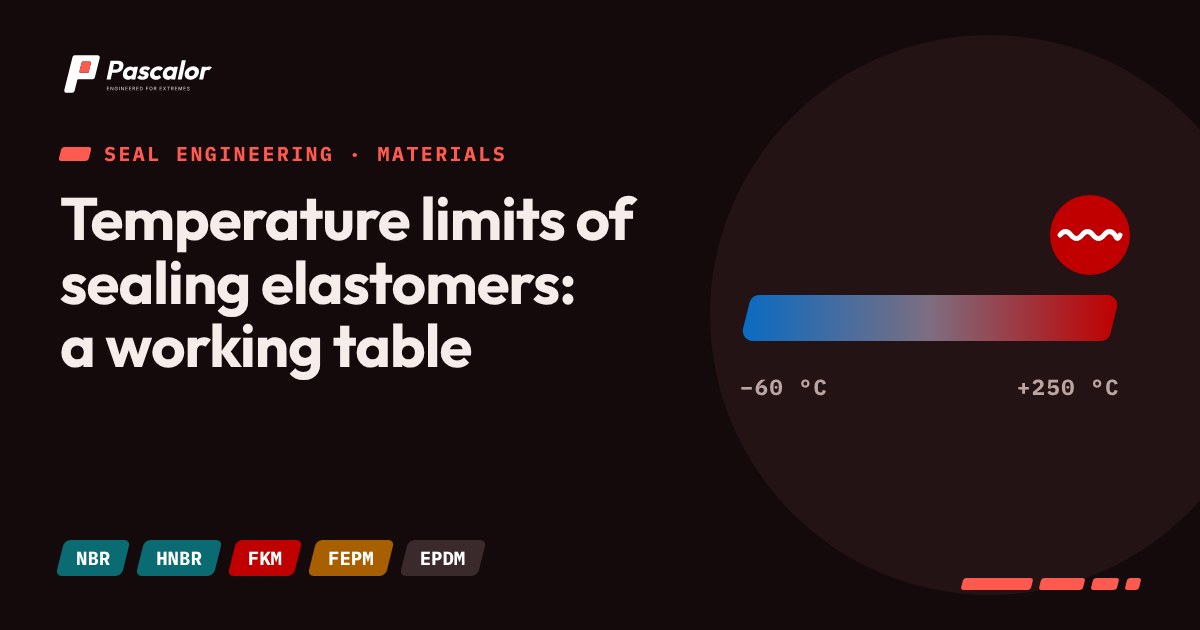
Ranges below are typical for standard compounds in dry air. Specific compounds can be better or worse. Fluids shift limits, so use these as a first screen only.
| Polymer | Typical low (service) | Typical high (continuous) | Comments |
|---|---|---|---|
| NBR (nitrile) | -30 to -40 degrees C | 100 to 120 degrees C | Oil and fuel resistant, ageing in heat and ozone |
| HNBR | -30 to -40 degrees C | 150 degrees C (peroxide, up to 165 short term) | Oil, sour gas, amines (better than NBR) |
| FKM (Viton-type) | -20 degrees C (standard), -40 or lower special | 200 to 230 degrees C | Oils, fuels, acids; weak to amines, steam, ketones |
| FEPM (Aflas-type) | -5 to -10 degrees C | 200 to 230 degrees C | Steam, amines, bases, sour fluids |
| FFKM | -15 to -25 degrees C | 260 to 300 degrees C | Almost universal chemical range; costly |
| EPDM | -45 to -55 degrees C | 130 to 150 degrees C | Steam, water, glycol; not mineral oil |
| Silicone (VMQ) | -55 degrees C | 200 degrees C | Wide range, poor tear and permeable |
| Fluorosilicone (FVMQ) | -60 degrees C | 175 degrees C | Fuel and oil with wide temperature range |
| Chloroprene (CR) | -35 degrees C | 100 degrees C | Weathering, refrigerants |
| ACM | -20 degrees C | 150 degrees C | Hot oil, automotive transmissions |
| AEM | -30 degrees C | 150 degrees C | Hot oil with good low temperature |
| Polyurethane (AU/EU) | -35 degrees C | 80 to 100 degrees C | Excellent wear, poor hot water |
What decides the limits
Low end. The glass transition and crystallisation set the stiffness floor. The practical sealing limit is usually 10 to 15 degrees warmer than the TR10 value. Dynamic duty needs more margin than static.
High end. Heat ageing: crosslink changes, oxidation, plasticiser loss. Peroxide-cured compounds usually outlast sulphur-cured ones. Fluid exposure may cut limits sharply.
Short-term versus continuous
Compounds tolerate excursions much above their continuous rating for hours, not weeks. Use the continuous rating for design and treat peaks as events to be validated.
Pressure and temperature together
At high temperature rubber is softer and extrudes at a lower pressure. HPHT service needs harder compounds, back-up rings and checked compression set.
What to ask
- Compression set data at your temperature.
- Aged property retention (hardness, tensile, elongation) at your temperature.
- Low-temperature data (TR10, brittleness, retraction).
- Fluid ageing in your medium.
HPHT and HPLT are duty families, not ratings; always quote the actual temperatures.