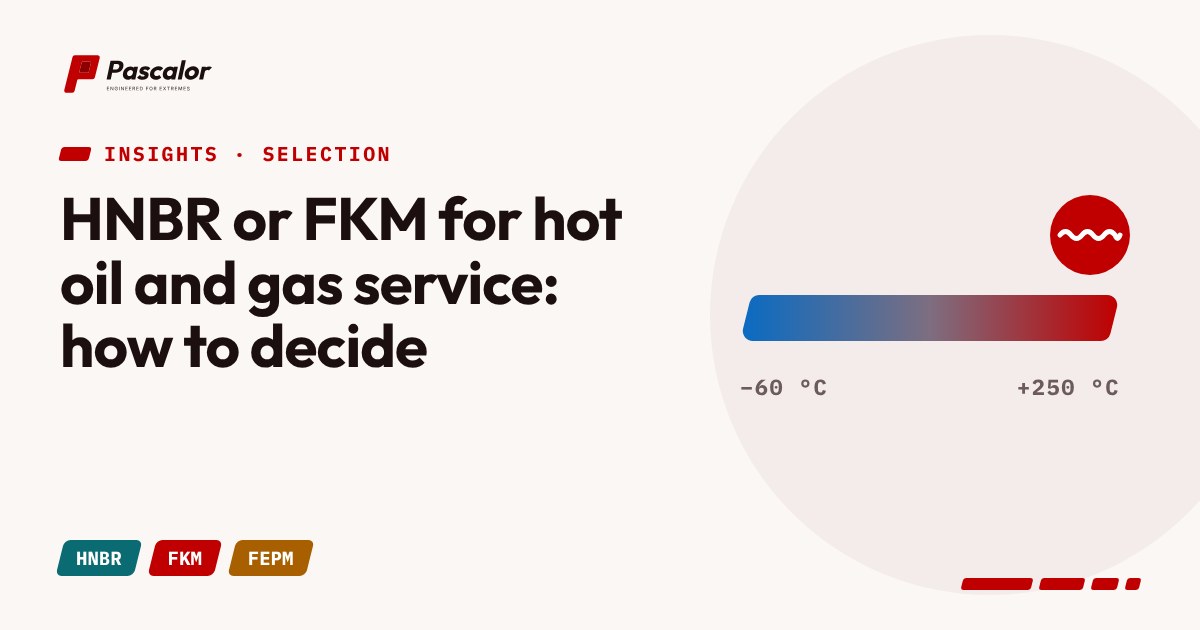
Buyers often ask for "the best rubber for downhole" or "the best rubber for hot oil". There is no such compound. There is a compound that fits your fluid, your temperature window and your pressure cycling, and that you can prove with test data. This note shows the questions that separate HNBR from FKM, and when a third option (FEPM) is worth a look.
Start with the fluid, not the temperature
Temperature gets quoted first because it is easy to write down. The fluid decides more often.
- Hot mineral oil and fuels, no strong amines: both families work. FKM usually keeps more of its properties at the top of the range. HNBR is tougher and stronger at lower cost.
- Amine-containing fluids and strong bases: standard FKM can harden and crack. HNBR and FEPM generally cope better, and peroxide-cured FKM grades sit in between. Ask for immersion data in your actual fluid, not a chart.
- Sour service (H2S): HNBR resists it only within limits that depend on temperature and acrylonitrile content. FKM and FEPM are usually considered first. State the partial pressure and temperature when you ask.
- Steam and hot water: FEPM is the usual candidate. Many FKM grades are weaker here, and the cure system matters.
Then the temperature window
Think of two ends. At the hot end, compare the aged properties you need (compression set after ageing, retained elongation), not only the headline limit. At the cold end, a general-purpose FKM becomes stiff well before it stops working at high temperature, and a high-nitrile HNBR gives up some low-temperature flexibility. If your seal must start cold and run hot, write both ends into the requirement. See the note on low-temperature FKM options for what to ask.
Pressure cycling and gas
If gas can dissolve in the rubber and the pressure then drops quickly, the compound needs to survive rapid gas decompression. That is a separate test, and it often points to a harder, more highly filled compound whatever the polymer. See the note on specifying for rapid gas decompression.
A short decision path
- Write down the fluids, including any amines, H2S, CO2, steam and inhibitors.
- Write down the minimum and maximum service temperature and how long it is held at each.
- Say whether pressure cycles quickly.
- Pick two or three candidates across HNBR, FKM and FEPM.
- Ask for immersion in your fluid at your temperature, plus compression set, plus (if relevant) gas decompression.
Where this note stops
These are general tendencies, not guarantees. Grades within a family differ a lot, and no compound holds an approval unless a certificate says so. Use the datasheet and your own tests to decide.
If you would like candidates proposed from your requirement, start a requirement and we will respond with options and the test plan.