Rubber grade names are often opaque. You get a code, you look it up and you find that it is a nitrile, or a fluoroelastomer, or something else. Our names tell you before you open a datasheet, and every part of them is a plain technical description: no invented words, no borrowed names, nothing to decode and nothing to license.
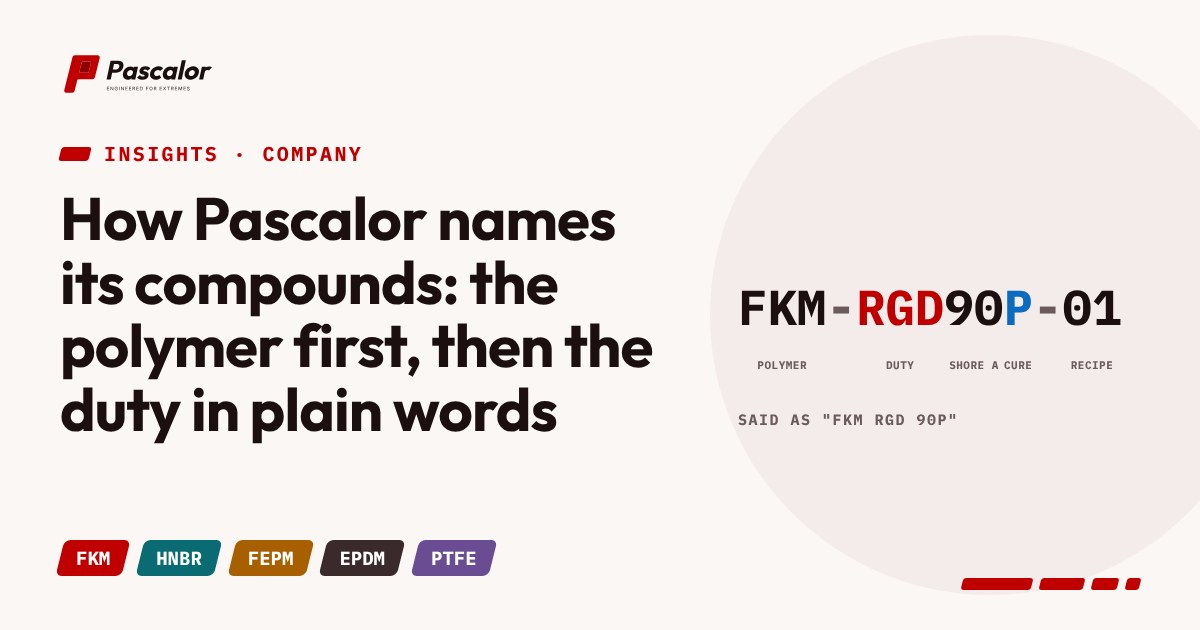
The pattern
[POLYMER]-[DUTY][Hardness][Cure]-[Recipe]
Example: FKM RGD 90P, written as the code FKM-RGD90P-01.
- Polymer: FKM, FFKM, FVMQ, HNBR, NBR, XNBR, FEPM, EPDM, NR, CR or PU, always first, in the ASTM D1418 abbreviation.
- Duty: what the grade is designed for, as a short code (the full list is below).
- Hardness: nominal Shore A.
- Cure: P peroxide, B bisphenol, S sulfur, X another system (metal oxide for chloroprene, a polyurethane system).
- Recipe number: a new recipe means a new number. A sibling grade for a different job gets its own duty code, never a new recipe number.
When a duty code ends in a digit, a hyphen keeps the hardness readable: HNBR-H2-80P-01 is said HNBR H2 80P, and FKM-CO2-90P-01 is said FKM CO2 90P.
The duty codes
| Code | Said as | Designed for |
|---|---|---|
| RGD | RGD | Rapid gas decompression (RGD) and high-pressure sour gas |
| LT | Low-Temp | Sealing under pressure at −40 °C or below (HPLT), often in equipment that also runs hot |
| ULT | Ultra-Low-Temp | Sealing under pressure at −55 °C or below: the coldest grade in its polymer |
| HT | High-Temp | The highest temperatures and longest lives |
| SOUR | Sour | Sour service: H2S, amine inhibitors and completion chemistry |
| CHEM | Chemical | Bases, amines, high-pH fluids and steam chemistry that attack standard FKM |
| CO2 | CO2 | CO2, carbon capture and methanol service |
| STM | Steam | Steam, hot water, condensate, geothermal and thermal power plants |
| PKR | Packer | Packer elements and anti-extrusion parts |
| BOP | BOP | Blowout preventer and pressure-control elements |
| WEAR | Wear | Abrasion and wear: strippers, RCD elements, pig cups, wipers |
| ESP | ESP | ESP protector bags, bonded parts and diaphragms |
| STAT | Stator | Mud motor and progressing cavity pump stators |
| SWELL | Swell | Swellable packers and seals |
| DIS | Dissolvable | Dissolvable completion elastomers |
| H2 | H2 | Hydrogen service: compression and storage, −40 °C dispensing, electrolysers, fuel cells and the gas grid |
| TRF | Transformer | Transformers, switchgear and electrical equipment |
| EHC | EHC | Turbine control (EHC) phosphate-ester fluids and fire-resistant hydraulics |
| RAD | Radiation | Nuclear power: radiation-resistant compounds |
| GATE | Gate | Hydro gates and water infrastructure |
| GEN | General | Reference O-ring and seal grades |
What a duty code promises, and what it does not
The code says what a grade is designed for. The qualification plan on its datasheet says what it has passed. A duty that needs a test, such as RGD, LT, ULT, SOUR, CO2 or H2, shows that test as planned until the report is on file, and the report reference is published when it is. HPHT and HPLT are our pole marks for service conditions, not certifications.
Filled PTFE names
PTFE grades follow the same first rule, the polymer first, then say what decides the choice for PTFE: the filler. Example: PTFE Glass 25, written as the code PTFE-GL25-01.
- Polymer: PTFE.
- Filler code: GL glass fibre, GM glass fibre with MoS2, CF carbon fibre, CG carbon-graphite, GR graphite, BZ bronze, BM bronze with MoS2, MS MoS2.
- Number: the nominal weight percent of the main filler. A second filler is stated on the datasheet.
- Recipe number: a new recipe means a new number.
Hardness for filled PTFE is Shore D and appears on the datasheet, not in the name, and there is no cure code because PTFE is sintered, not cured.
Lot numbers
A lot number adds the year, the month and a three-digit sequence to the grade: FKM-RGD90P-01-2703-001 is the first lot of FKM RGD 90P made in March 2027. Enter it under Track to see the lot record.
What the name does not do
It does not claim approvals, and it does not claim a rating. Every property claim in a datasheet carries its test method and conditions, and every number is labelled as a target, a typical value or a limit.