A mixing cycle is a set of instructions that must work every time. A good one is written down, based on data and strict about what ends each stage.
Start from the compound's constraints
- What must not happen. Scorch (the cure starts), polymer degradation, plasticiser loss, over-heating of oil, filler damage.
- What must be achieved. Dispersion to a standard, viscosity within a Mooney window, uniform density.
- What the machine can do. Chamber volume, rotor type, speed range, cooling capacity.
The variables in practice
Fill factor. Calculate batch weight from chamber volume, fill factor and compound density. Start at the middle of the supplier's recommended range, and adjust based on ram behaviour: if the ram rides high and never seats, increase the batch weight. If it bottoms out immediately and the batch is dead on the rotors, reduce it.
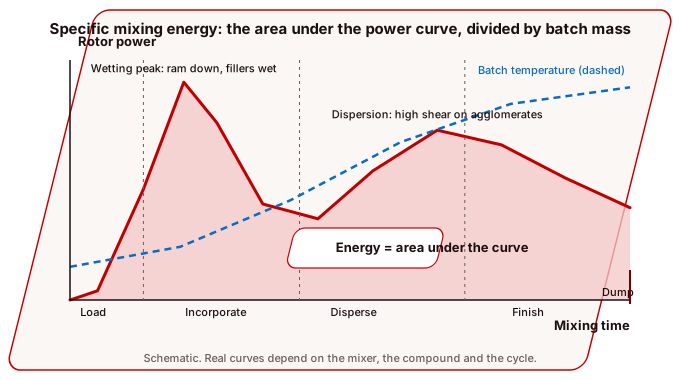 Figure. Mixing power and specific energy. The area under the power curve, divided by the batch mass, is the specific energy put in.
Ram pressure. Raise it until the ram seats firmly on the batch. More pressure shortens incorporation time but increases temperature rise.
Rotor speed. Use a lower speed for the first addition if the polymer is stiff and cold, and a higher speed when filler needs shear. Speed profiles that change by stage are standard on modern mixers.
Starting temperature. Cold polymer is hard to bite and wastes energy. Hot chamber walls at the start can lead to temperature overshoot. Keep the machine at a defined temperature before each batch.
The dump criterion
A mixing stage can end on:
- Time: simple but sensitive to variation in raw material and start temperature.
- Temperature: protects the compound from over-heat but not from under-mixing.
- Energy (kWh per batch): integrates power over time and correlates well with dispersion for a given compound.
- A combination, such as "dump at 130 °C or at an energy of X, whichever comes first, with a minimum time".
For critical compounds, use energy plus temperature limits. Keep a record of both.
Controlling variation
- Weigh to tight tolerances and log raw-material lot numbers.
- Use the same polymer bale or pellet size and temperature.
- Run a standard "check" compound regularly and watch the power curve.
- Plot ML and ts2 as control charts from every batch, and investigate trends before they trigger rejection.
A final cycle versus a masterbatch cycle
A masterbatch stage has the highest shear and temperature, so its dump temperature is the highest. A productive stage with curatives has the lowest, because its whole job is mixing in the curatives without starting the cure. Write each stage's targets separately.
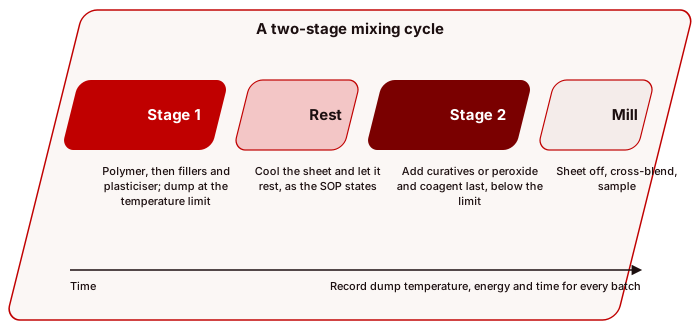 Figure. A two-stage cycle: stage 1, rest, stage 2, mill.