The open two-roll mill
Two horizontal, water-cooled rolls turn towards each other at different speeds. The operator feeds rubber into the nip, cuts and folds the band, and adds ingredients by hand.
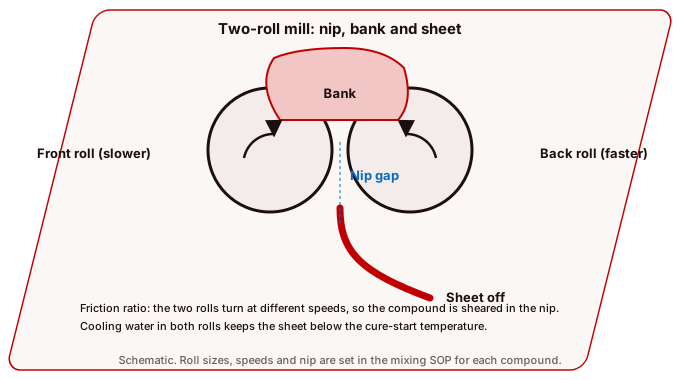 Figure. The nip, the bank and the sheet on a two-roll mill.
Good for: small batches, development work, warming up compound, adding curatives at low temperature, sheeting off, silicone and fluoroelastomer gum, and visual control.
Limits: operator-dependent, slow for large batches, open to dust and fumes, and less intense than an internal mixer for filler dispersion.
The internal mixer
A closed chamber with two rotors, ram and cooled surfaces. It turns a large batch into a uniform compound in minutes.
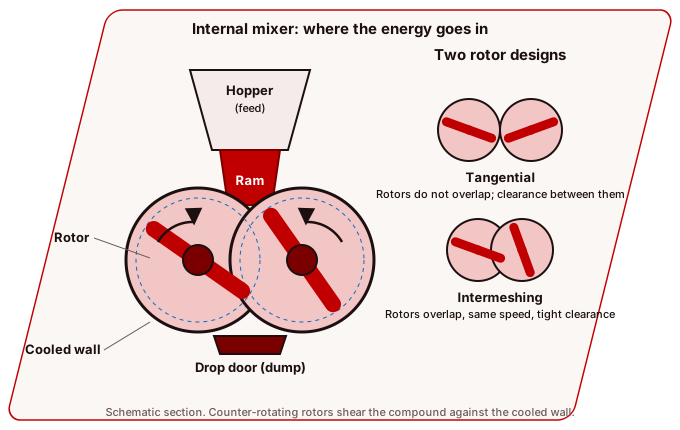 Figure. Section through an internal mixer, with the two common rotor designs.
Good for: production masterbatches, high filler levels, large batches, repeatable cycles with data logging.
Limits: needs minimum batch size, expensive, and heat build-up can scorch sensitive recipes.
Using both
Many plants use the internal mixer for the masterbatch and a mill or a cooled final mixer for the productive stage. Development labs use a small internal mixer to represent production and a mill for curative addition.
Choosing quickly
| Situation | Choose |
|---|---|
| Testing a new recipe at 300 g | small mixer or mill |
| Scorch-sensitive final addition | mill or cooled mixer |
| 100 kg of filled compound | internal mixer |
| Silicone gum with silica | kneader or mill |
| Compound that must be visually checked | mill |
Whichever you use, record what you did and keep the parameters the same from batch to batch.