

A seal works because it is squeezed and pushes back. Over time at temperature, the rubber relaxes and some of that push is lost, and when the squeeze is removed the rubber does not return to its original thickness. Compression set measures how much thickness is not recovered. It is the single most useful number for predicting whether a static seal will keep sealing.
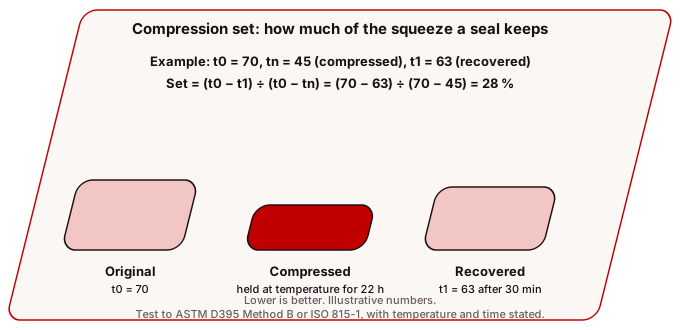
How it is measured
In ASTM D395 method B (and the similar ISO 815-1), a disc or button of rubber is held between plates at a fixed compression, usually 25%, for a set time at a set temperature. The sample is then released, left to recover for a fixed period, and its thickness is measured again. The result is the percentage of the applied compression that has not recovered. Lower is better. Zero means full recovery, and 100% means the rubber stayed fully squashed.
Typical conditions are 22 h or 70 h at the test temperature (for example 150 °C for HNBR, 200 °C for FKM). The test can also be run on O-rings, as in ASTM D1414.
What drives compression set
- Cure state. An under-cured compound has a loose network and relaxes. A stable, tight network recovers. Peroxide systems with a good coagent and bisphenol systems with sufficient post-cure give low set.
- Post-cure. Fluoro-rubbers are post-cured in an oven for hours to complete cure and drive off volatile by-products. Skipping or shortening it increases set.
- Polymer type. FKM generally gives low set at high temperature. HNBR does well at moderate temperature. FEPM usually shows higher set than FKM.
- Filler. Low-structure, low-reinforcement fillers such as MT black help. High filler loadings and highly reinforcing grades tend to increase set.
- Plasticiser and processing aids. Volatile or extractable plasticisers can leave and increase set.
- Temperature and time. Set rises with both. Always check the test temperature when comparing.
Why numbers are not always comparable
Two lab reports that both say "compression set 15%" can describe very different materials.
- Specimen: a disc, a button and an O-ring give different results at the same conditions, and the cross-section size matters.
- Method and compression: method B (constant deflection) and method A (constant force) are different tests, and 25% is not the only compression in use.
- Time and temperature: 22 h and 70 h differ, and so do 150 °C and 200 °C.
- Cooling: whether the sample is cooled under compression before release changes the result.
- Recovery time: the rest period before measurement.
- Post-cure: whether the specimens were post-cured as production parts would be.
When you compare quotes, ask for the specimen, method, percent compression, time, temperature and post-cure for each number.
Setting a limit
A limit should come from the application, not from a datasheet value. If a seal in your design may lose no more than 40% of its compression over its life, you can work backwards to a laboratory test that screens for that. Specifications in the D2000 system express compression set as a requirement with method, time and temperature letters.
Using compression set in batch control
Compression set is a slow test, so it is often run on every batch for critical parts, and on a schedule for others, with faster checks such as hardness, density and cure rheometer data on every batch. Rheometer values such as MH are an indirect guide to cure state and can warn of a problem before the compression-set result arrives. Tracking compression set across batches, as the Pascalor batch passport does, shows slow drift that a single pass or fail would hide.
Sources and further reading
- ASTM D395 (compression set), ASTM D1414 (O-ring testing), ISO 815-1.
- See the Testing page for the full method index.