

A moving-die or rotorless rheometer takes a small sample of uncured compound, heats it to the cure temperature, and oscillates the die at a small angle while measuring torque against time. The resulting curve is a picture of the cure, and it is the quickest way to see whether a batch behaves like the last one. The standard methods are ASTM D5289 and ISO 6502-3.
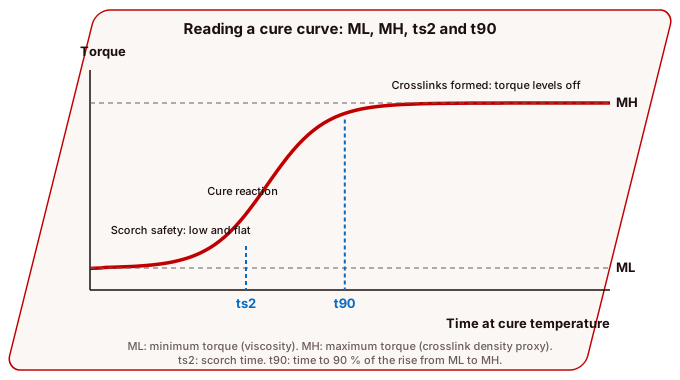
The curve in four steps
- Start. The torque starts at a level that depends on how stiff the uncured rubber is.
- Minimum torque (ML). The compound softens as it heats, so torque dips to a minimum. ML reflects the viscosity of the heated compound. A rise in ML between batches suggests higher polymer viscosity, more filler or poor mixing.
- Cure. Crosslinks form and torque rises. The slope is the cure rate.
- Plateau or maximum torque (MH). Torque levels off as cure completes. MH is a rough measure of crosslink density. A fall in MH suggests under-cure or a shortage of curative. A rise suggests extra curative or filler.
The time points
- ts2 (scorch time). Time for torque to rise 2 units above ML. It tells you how long the compound can sit at temperature before it starts to cure, which matters for injection moulding and mould filling. A short ts2 means less processing time.
- t50 and t90. Times to 50% and 90% of the full torque rise. t90 is often used to set the minimum press cure time for the part, adjusted for part thickness and mould heat transfer.
- Cure rate index. Sometimes quoted as 100 divided by t90 minus ts2.
Two shapes to know
- Reversion. Torque falls after the maximum. It can mean the network is being damaged at that temperature and time. This is common in some sulfur systems and is a warning in others.
- Marching modulus. Torque keeps rising slowly and never reaches a clean plateau. It suggests continuing cure, so the cure time should be set from a fixed criterion.
Using the numbers
- Release limits. Set minimum and maximum limits for ML, MH, ts2 and t90 based on measured batch data for that compound. The Pascalor batch passport shows a lot's values against these limits.
- Compare like with like. Test temperature, arc, frequency and test duration change the results. Always state them.
- Trends matter more than single values. A small drift in MH over six batches can signal an ingredient lot change before any physical test fails.
- Rheometer data does not replace physical tests. It indicates cure state, but compression set and tensile properties still need to be measured.
Sources and further reading
- ASTM D5289 and ISO 6502-3 for rotorless curemeters; ASTM D1646 for Mooney viscosity and scorch.
About this guide. It is an original summary written from public sources and standards. It is not a copy of any standard or book, and it is not engineering advice. Confirm values against the current edition of the standard and test in your own application.