

As rubber cools it stiffens, then becomes leathery, then glassy. A seal is useless when it can no longer follow the movement of the metal parts and keep a contact pressure. Several tests describe the cold behaviour, and each answers a different question.
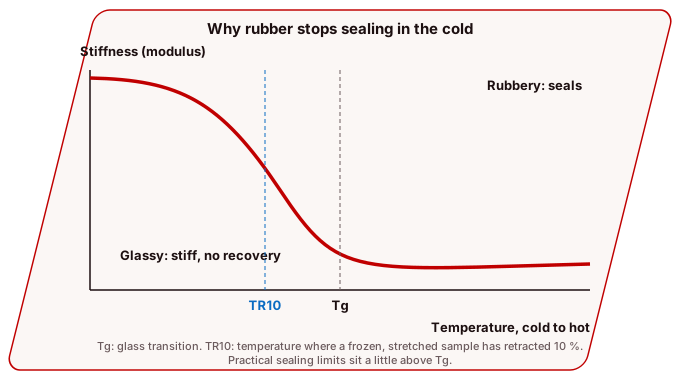
The measures
- Glass transition temperature (Tg). The temperature at which the polymer changes from rubbery to glassy, usually measured by DSC (ASTM E1356, ISO 22768) and quoted for raw polymer. It is a material property.
- TR10 (temperature retraction). A stretched specimen is frozen, then warmed at a set rate. The temperature at which it retracts by 10% is TR10 (ASTM D1329, ISO 2921). TR10 is often quoted as the practical lower limit for flexibility, and is often a few degrees above Tg. TR30, TR50 and TR70 are also reported, and a wide gap between TR10 and TR70 means a slow recovery.
- Brittleness temperature. The temperature at which a specimen breaks under impact (ASTM D2137). It is lower than TR10 and describes survival without breaking, not sealing.
- Gehman or similar stiffness tests. Measure how stiff the rubber becomes as it cools.
- Low-temperature compression set and leak tests. Most relevant for seals, and tested on the part.
Why a datasheet number can mislead
- TR10 is measured on a stretched specimen in tension, and a seal in compression at the same temperature behaves differently.
- A seal also has to recover when pressure and movement change. A material that is stiff but recovers slowly can leak during thermal cycles.
- The values quoted for a raw gum are not the same as those for the compound. Fillers, plasticisers and cure system shift the result by several degrees.
- Fluids swell the rubber and change the cold behaviour. A seal that has absorbed plasticiser-like fluid may be softer or may lose its plasticiser and stiffen.
Typical ranges
As general guidance, standard FKM grades have TR10 values around -15 to -20 °C. Terpolymers with high fluorine are warmer, and low-temperature FKM grades using PMVE reach about -30 °C or lower according to supplier data (TR10 is quoted per grade on the producer's datasheet). HNBR spans a wide range depending on ACN content, with low-ACN grades the best. Standard FEPM is near 0 °C and is a poor choice in the cold unless a modified grade is used.
Design and selection tips
- Choose the lower limit with margin, usually at least 10 °C below the coldest temperature the seal will see in service.
- Test in the actual fluid at the actual temperature if the application is critical.
- If you need both high and low temperature performance in one seal, you may need a low-temperature peroxide FKM or a different seal design.
Sources and further reading
- ASTM D1329 and ISO 2921 (TR test), ASTM D2137 (brittleness), ASTM E1356 and ISO 22768 (Tg by DSC).
About this guide. It is an original summary written from public sources and standards. It is not a copy of any standard or book, and it is not engineering advice. Confirm values against the current edition of the standard and test in your own application.