

Rapid gas decompression (RGD), also called explosive decompression, is a failure mode of elastomer seals in high-pressure gas service. It is a main reason seal materials for oil and gas equipment are qualified in a special test, and it is why a compound that passes every normal test can still fail in a gas well.
The mechanism
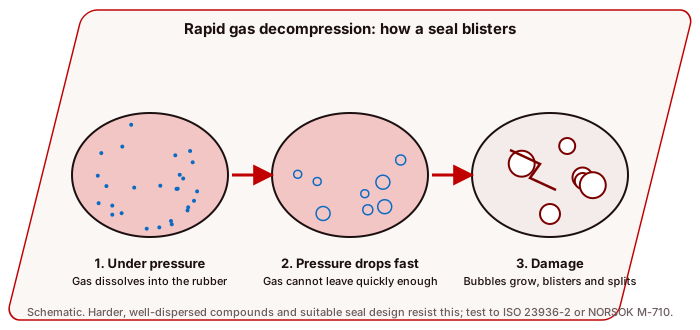
Under high pressure, gas dissolves into the rubber. The amount depends on the pressure, the temperature and how soluble the gas is in the polymer, and carbon dioxide dissolves much more readily than methane in most elastomers. If the pressure is lowered slowly, the gas diffuses out through the surface and nothing happens. If it is lowered quickly, the gas inside cannot escape in time. The dissolved gas comes out of solution as bubbles inside the rubber. These grow, and where they join they form cracks and blisters. In a seal, this can cut the cross-section or leave it split, and the seal fails once it is back in service.
What affects it
- Gas and pressure. More dissolved gas gives a greater risk. Carbon dioxide is more damaging than methane.
- Decompression rate. Faster decompression gives more damage.
- Temperature. It changes both gas uptake and how easily the gas leaves and how strong the rubber is.
- Seal cross-section and shape. Thicker sections hold gas longer and are more at risk.
- The compound. Higher modulus and better tear strength resist bubble growth. Elastomer type, filler and cure system all matter, and a compound designed for RGD resistance is not the same as a general-purpose one.
- Seal fit. Confinement in a well-fitted groove with limited free space supports the seal, while a poorly supported seal can burst more easily.
How it is tested
The industry route is the rapid gas decompression test in NORSOK M-710 (Annex B) and ISO 23936-2 (Annex B). Seals, normally O-rings of a stated cross-section, are exposed to a high-pressure gas mix at elevated temperature, then decompressed at a stated rate, repeated for several cycles. After the test, each O-ring is cut into sections and examined under magnification for internal cracks, holes and blisters. The damage is rated on a scale from 0 (no damage) to 5, and each material receives a rating based on the worst result.
Other documents set stricter conditions, such as operator specifications. Parameters differ between editions and sources, so any qualification claim must name the standard, edition and conditions. See the RGD report on this site for a comparison table and a report template.
What this means for buyers
- Ask for the standard, edition, gas mix, temperature, pressure, decompression rate, O-ring size and rating, with the laboratory's name and report number.
- A rating applies to a specific compound and cross-section. A different size, hardness or recipe needs its own evidence.
- Do not accept a claim such as "RGD resistant" without a report.
What this means for sellers
A supplier should list qualification reports against each compound. Where none is listed, treat the compound as not qualified. Qualification costs real money and months of laboratory time, so it should be planned around a specific customer need and a specific recipe.
Sources and further reading
- Infinita Lab: Rapid gas decompression testing and James Walker: RGD testing.
- ISO 23936-2 and NORSOK M-710 (buy the current edition).