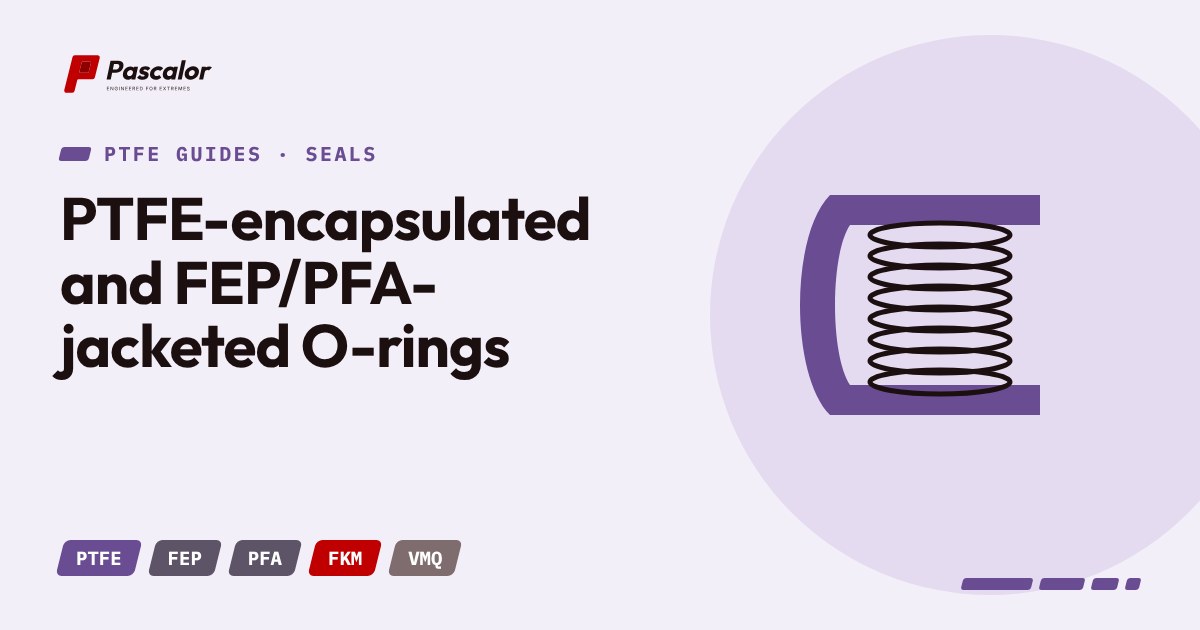
An encapsulated O-ring has an elastomer core (usually silicone or FKM) inside a seamless or welded jacket of FEP or PFA. The jacket stops the fluid reaching the rubber; the core gives the spring.
Jacket and core choices
| Part | Options | Notes |
|---|---|---|
| Jacket | FEP | Lower cost, up to about 200 degrees C |
| Jacket | PFA | Better temperature range, about 260 degrees C, tougher |
| Core | Silicone (VMQ) | Soft, wide temperature, low compression force |
| Core | FKM | Firmer, better compression set at high temperature |
| Core | Hollow metal spring or tube | Higher load, special |
What they do well
- Chemical resistance of PTFE-type material with a ring shape.
- Clean, low extractables, suitable for food, pharma and semiconductor lines when certified.
- Standard O-ring groove sizes, with changes in squeeze.
Limits
- Stiffness. The jacket is much stiffer than the core, so the ring needs more force to compress. Lightly loaded flanges may not reach squeeze.
- Dynamic use. Limited. Jacket can crack or wear.
- Seam. FEP-jacketed rings have a weld seam. Position it away from the sealing face if possible.
- Permeation. Gases permeate the jacket and can build up in the core. Rapid decompression can blister it.
- Gland rules. Use the maker's squeeze, stretch and groove fill guidance, which differ from rubber O-rings.
- Not for repeated heavy deformation. The jacket does not recover completely after a hard compression.
Where used
Oven door seals, heat-exchanger covers, valve bodies in chemical plants, pharmaceutical vessels, high-purity fittings.
When a different choice is better
For static seals at moderate temperature, FFKM or a standard FKM compound may do the job at lower cost. For high pressure, spring-energised PTFE or metal seals are preferable. For dynamic motion, a PTFE-jacketed U-seal is usually better.
About this article. It is original writing prepared from public sources, standards and general industry practice. It is not a copy of any book or standard and it is not engineering advice. Confirm values against the current edition of the standard and test in your own application. Only analyse material you own or are entitled to analyse.