PTFE melts to a clear gel of enormous viscosity that never flows like a normal thermoplastic melt. Parts are therefore made by powder metallurgy-style routes: pack powder, fuse it by heat, then cool carefully.
Compression moulding and sintering
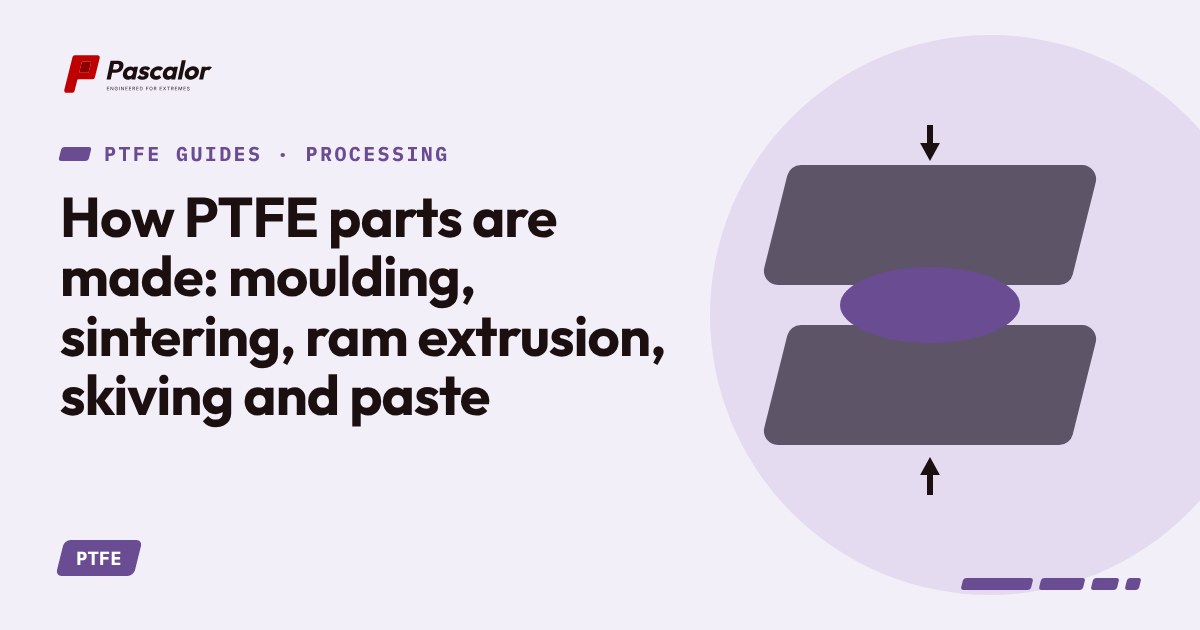
- Preform. Powder is pressed in a die at roughly 20 to 70 MPa into a self-supporting block.
- Sinter. The preform is heated, typically to 360 to 380 degrees C, and held long enough for the particles to fuse. Hold time grows with thickness.
- Cool. Cooling rate controls crystallinity. Slow cooling gives higher crystallinity and higher density, hardness and stiffness. Fast cooling gives a tougher, more translucent part.
- Machine. Billets, rods or tubes are machined to final shape.
Filled grades are made the same way, after the filler has been blended into the powder. Blend quality decides whether wear properties are uniform.
Isostatic moulding
Powder in a flexible bag is pressed from all sides in a fluid. Density is more uniform, so large or complex shapes with less machining are possible, and distortion is lower than from a uniaxial press.
Ram extrusion
Powder is fed continuously into a heated die by a reciprocating ram. Output is long rod and tube. Each stroke adds a short fused segment. The weld between segments is usually the weakest region, which is worth knowing for thin-wall tube.
Skived sheet and film
A rotating billet is shaved by a sharp blade into continuous sheet or tape. Thickness from about 0.025 mm upward. Skived film is the base for gaskets, liners and wrapped products.
Paste extrusion
Fine powder is mixed with a lubricant, extruded through a die into tape, tube or wire insulation, then the lubricant is driven off and the part sintered. This is how thin-wall tubing and cable insulation are made. Expanded PTFE (ePTFE) is made by stretching paste-extruded tape before sintering.
Dispersions
Aqueous PTFE dispersions coat fabrics, glass and metal. After drying the coating is baked above the melting point.
What changes from route to route
| Route | Strengths | Watch for |
|---|---|---|
| Moulded billet | Dense, good for machining | Density gradient in thick sections |
| Isostatic | Uniform, near net shape | Equipment cost, lead time |
| Ram extruded | Long lengths, economical | Segment weld lines, orientation |
| Skived | Thin sheet and film | Surface scoring, direction of grain |
| Paste extruded | Thin walls, fine tube | Lubricant residue if undercured |
Quality tie-in
Voids, micro-cracks and under-sintering lower density and strength. Density, tensile and elongation on cut-ups are the practical checks. Ask for lot certificates, and for the standard the material meets (see the testing article).