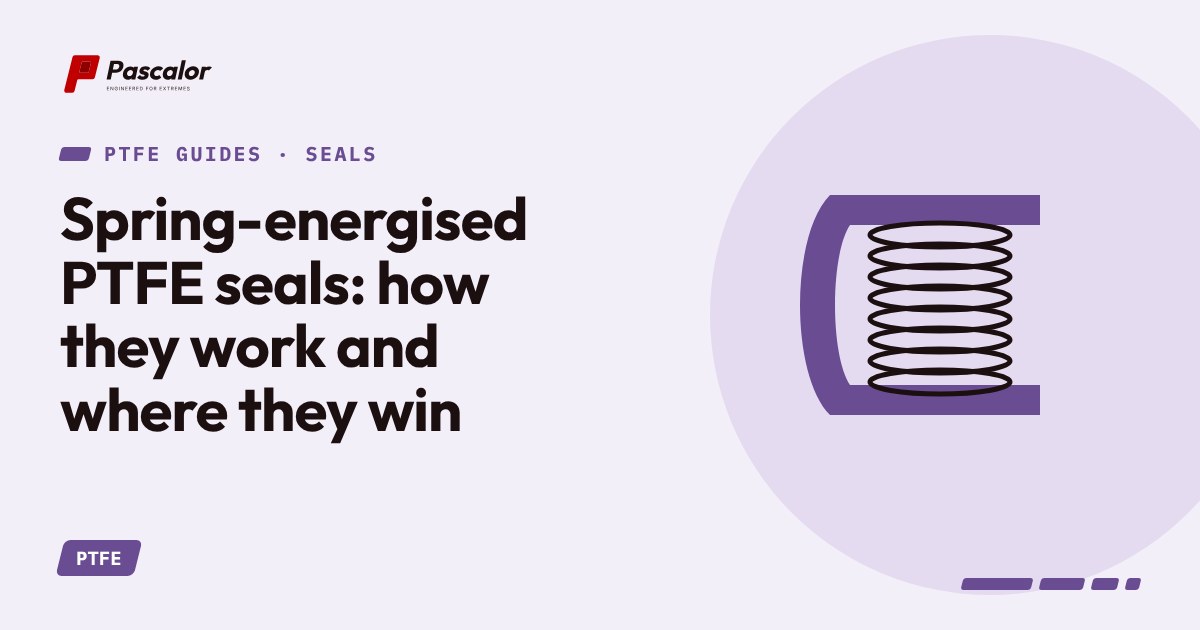
A spring-energised seal is a U-shaped jacket made of PTFE (or another polymer) with a metal spring in the groove of the U. The spring provides the load that PTFE cannot provide for itself. System pressure then adds to the seal force, so the seal tightens as pressure rises.
Why use one
- Works from cryogenic to roughly 260 degrees C, or higher with special jackets.
- Handles aggressive chemicals, including those that destroy elastomers.
- Low friction and no stick-slip, so good for slow or intermittent motion.
- Long shelf life. PTFE does not age like rubber.
- Spring keeps the seal energised even as the jacket creeps or wears.
Spring types
| Spring | Behaviour | Typical use |
|---|---|---|
| V-spring (cantilever) | Moderate load, good deflection | Rotary and reciprocating, general |
| Helical (coil) spring | Light load, low friction | Low-pressure, slow rotary |
| Canted coil | Nearly constant load over a wide deflection | Static, rotary and reciprocating where compression varies |
Spring material depends on the fluid: stainless steel for general use, Elgiloy or Hastelloy for sour gas and acids, Inconel for high temperature.
Jacket materials
Virgin PTFE for chemical and food use. Glass or carbon-filled PTFE for wear. Bronze-filled for heavy dynamic load. Polyimide, PEEK or UHMWPE for special duty. Match the jacket to the counterface, as in the filled-PTFE articles.
Design checks
- Groove geometry. Follow the seal maker's gland drawing. The sealing lips depend on the groove depth and width.
- Surface finish. Dynamic faces around Ra 0.2 micrometres, static a little rougher. Hard chrome, nitride or hardened steel for the dynamic surface.
- Lead-in chamfers and radii. PTFE can be cut on sharp edges during assembly.
- Clearance. Excessive extrusion gap lets the jacket flow. Add back-up rings in high-pressure designs.
- Assembly. Many are installed by stretching or by split grooves. Use the maker's tool and heat guidance.
- Leakage expectation. A metal-sprung PTFE seal is very good but not zero-leak in dynamic service; state the acceptable rate.
Where they replace rubber
HPHT oil and gas tools, LNG and cryogenic valves, semiconductor chemical lines, aggressive-chemical pumps and sterile pharmaceutical equipment.
When not to use them
Where very low cost is key, where the groove cannot be machined to tolerance, or where an elastomer is entirely adequate. They cost many times more than an O-ring.