Both families seal well in the right place. The mistake is to use one where the other belongs.
Side by side
| Feature | Elastomer (FKM, HNBR, EPDM...) | PTFE and filled PTFE |
|---|---|---|
| Elastic recovery | High | Almost none |
| Temperature range | Narrower per polymer | Very wide, cryogenic to about 260 degrees C |
| Chemical range | Depends strongly on polymer | Widest |
| Friction | Higher, stick-slip possible | Very low, no stick-slip |
| Compression set | A design limit | Creep is the equivalent limit |
| Gas permeation | Good in tight designs | Higher |
| Shelf life | Limited, ageing | Excellent |
| Cost per seal | Low | Higher |
| Installation | Easy, stretch fit | Needs care, some designs split-groove |
| Surface needs | Moderate | Tighter finish and hardness |
Use an elastomer when
- A standard O-ring groove is available and fluids/temperature fit.
- Cost and availability matter.
- Static sealing at moderate pressure.
- You need good gas sealing and elastic make-up for eccentricity.
Use PTFE when
- The fluid or temperature kills rubber.
- Friction, speed or stick-slip is a concern.
- Long shelf life or no ageing is required.
- Cryogenic duty.
- Purity matters.
Use both
- PTFE-jacketed seal with an O-ring or spring inside. The jacket resists the fluid, the energiser gives elasticity.
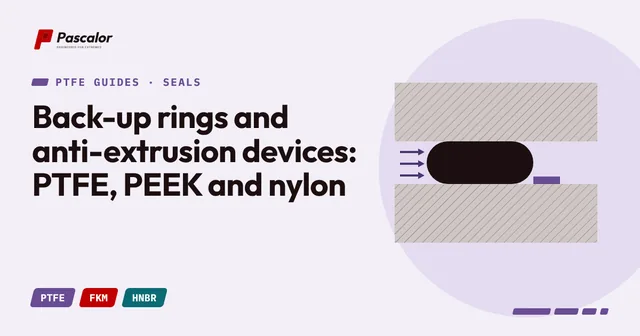
- PTFE back-up ring with an elastomer O-ring. The back-up stops extrusion at high pressure.
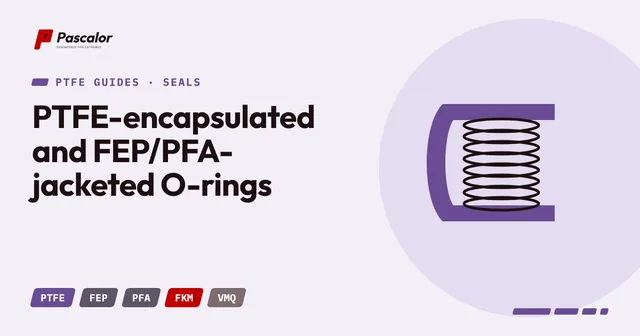
- PTFE-encapsulated O-ring. A thin FEP or PFA skin over silicone or FKM.
- PTFE-lined metal or rubber diaphragm.
Questions that settle it
- What is the highest and lowest temperature in service and during upset?
- What is the worst fluid, including cleaning agents?
- Is the motion static, reciprocating, rotary or oscillating, and how fast?
- What leak rate is acceptable?
- What does a failure cost?
When the elastomer answer is marginal, a better rubber (FKM to FFKM, HNBR to FEPM) is often cheaper than PTFE. When it is clearly out of range, move to PTFE.
About this article. It is original writing prepared from public sources, standards and general industry practice. It is not a copy of any book or standard and it is not engineering advice. Confirm values against the current edition of the standard and test in your own application. Only analyse material you own or are entitled to analyse.