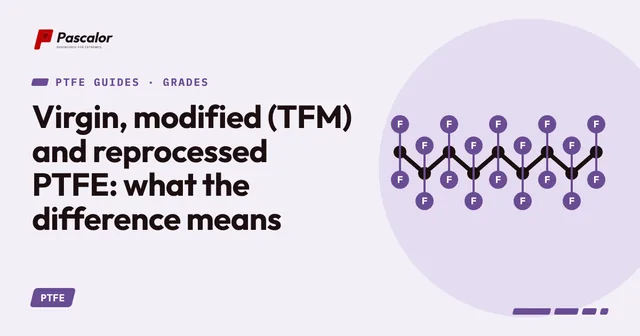
Polytetrafluoroethylene (PTFE) is a straight chain of carbon atoms, each carrying two fluorine atoms. The fluorine sheath is tight, strong and non-reactive. Almost everything useful and almost everything awkward about PTFE follows from that.
What the structure gives you
- Chemical resistance. The carbon-fluorine bond is one of the strongest in organic chemistry, and the sheath shields the carbon backbone. Acids, bases, solvents, fuels and most process chemicals do not attack it.
- Heat tolerance. It does not melt like an ordinary thermoplastic. The crystals melt near 327 degrees C into a gel that does not flow, which is why PTFE is sintered, not injection moulded. Continuous service is commonly quoted up to about 260 degrees C.
- Low friction. Surface energy is very low. Little sticks to it, and the chains shear easily past each other.
- Electrical performance. Very low dielectric constant (about 2.1) and loss, stable over a wide frequency and temperature range.
- Cryogenic toughness. It stays useful far below the temperatures where most rubbers turn glassy, down to liquid-nitrogen range and beyond.
What the structure takes away
- Creep and cold flow. The chains slip under sustained load. A PTFE seal or gasket gradually loses its clamping force.
- No elasticity. PTFE is not a rubber. It does not spring back, so it needs an energiser, an O-ring behind it or a spring to seal.
- Poor wear resistance when unfilled. Fillers fix this (see the filled-PTFE articles).
- High thermal expansion. Around ten times that of steel, with a crystal transition near room temperature that changes dimensions by about 1 percent.
- Gas permeability. Gases pass through PTFE more easily than through many elastomers.
- Poor bonding. The surface repels adhesives. Etched grades or mechanical locking are used when it must be bonded.
Where PTFE sits next to rubber
Rubber seals by elastic recovery and pays for it with limited chemical or temperature range. PTFE seals by conforming under load and pays for it with creep. Many of the best seals combine both: a PTFE jacket with an elastomer or metal spring inside.
Safety note
PTFE is safe in normal use. Heated above roughly 300 degrees C it releases fumes that can cause flu-like illness (polymer fume fever) if inhaled, and far above that it releases toxic breakdown products. Keep tobacco away from PTFE dust, ventilate sintering and machining of heated material, and never exceed the supplier's temperature limit.