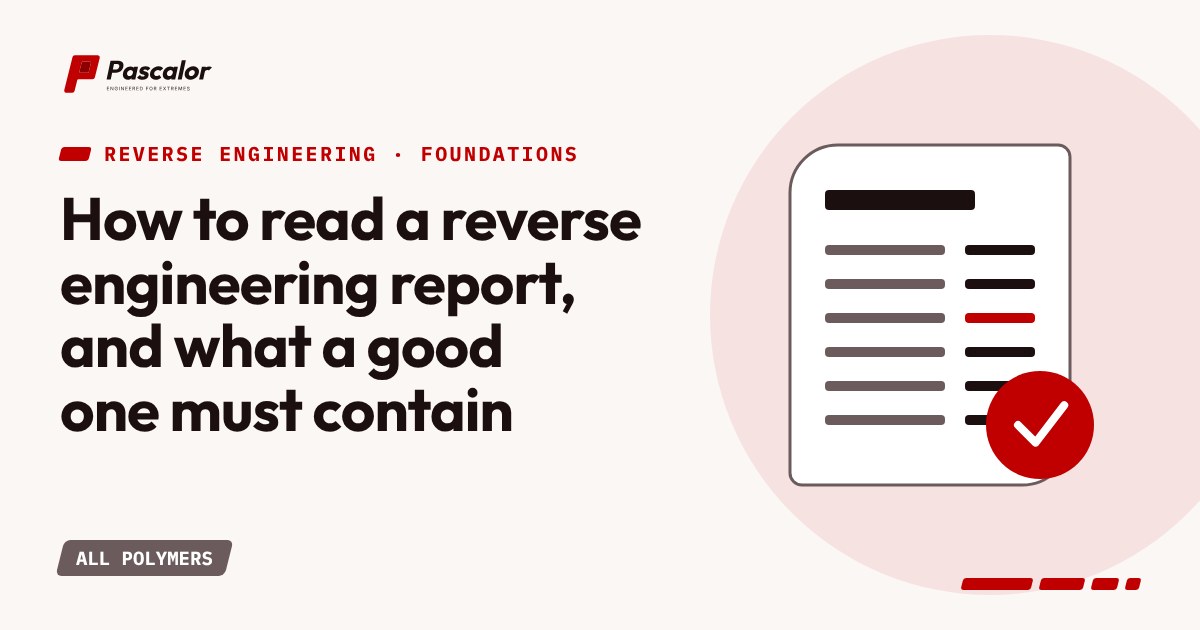
A report is only useful if you can tell how far to trust it. Look for these seven things.
1. A scope that matches your question
The first page should say what was asked, what sample was received (with identification and condition), and what level of analysis was done: identify, profile or match.
2. Methods stated for every result
"Polymer: HNBR" is not enough. "Polymer: HNBR, identified by ATR-FTIR and pyrolysis-IR, confirmed by Tg −34 °C (DSC, 10 °C/min)" is. Every number should have its method and conditions beside it.
3. Results in weight percent and phr
Weight percent is what was measured. Phr is what was calculated. A good report shows both and explains the conversion and any corrections, such as the sulfur correction.
4. Ranges where precision is limited
Blend ratios, oil types and accelerator identifications rarely deserve a single number. Look for ranges and qualifiers such as "sulfenamide-type accelerator" instead of a made-up name.
5. A physical property table with conditions
Hardness, density, tensile, modulus, elongation, compression set, fluid swell and low-temperature tests, each with standard, temperature, time and sample type.
6. A candidate formulation clearly labelled as such
A reconstructed recipe is a hypothesis. Look for words like "proposed" or "estimated" and a statement of how it will be validated.
7. A limitations section
What the analysis could not determine: exact curatives, supplier grades, mixing history, trace additives. Also the rights statement: who confirmed the right to analyse the sample, and a statement that no approvals are implied.
Red flags
- A single "exact formula" with no uncertainty.
- No method references.
- Percentages adding to well over or under 100 without comment.
- Silence about limitations.