The idea
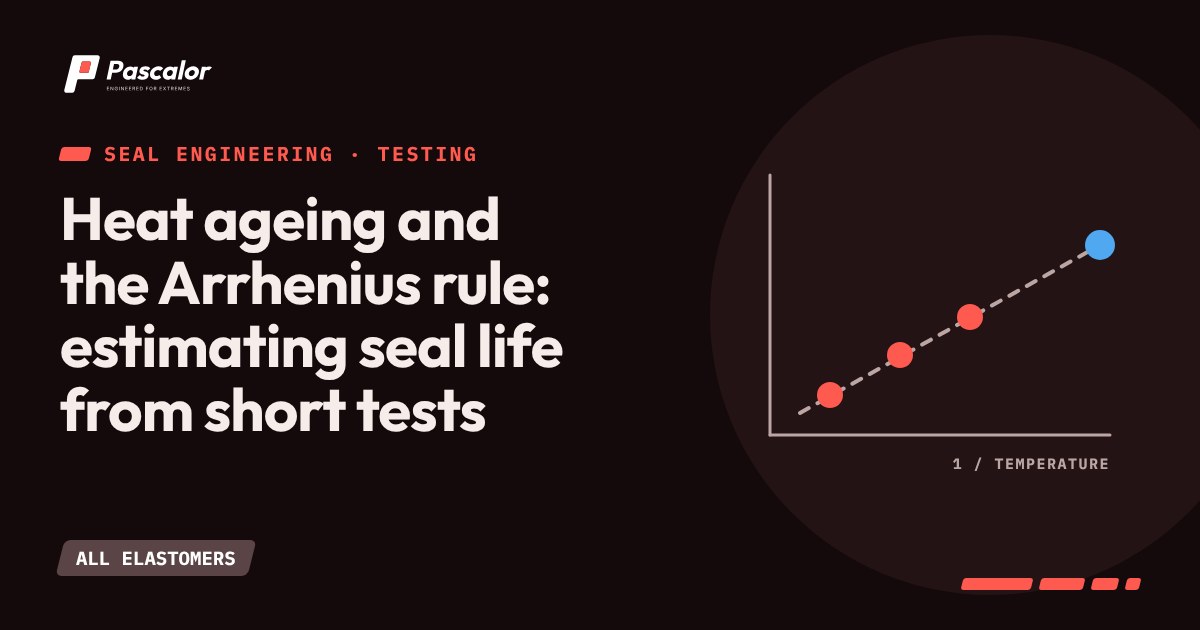
Chemical ageing rates roughly double for every 10 degrees C rise (the exact factor depends on activation energy). If you age samples at three or more elevated temperatures until a property reaches a failure limit, you can plot the logarithm of time-to-failure against the reciprocal of absolute temperature (1/T). The points fall near a straight line (an Arrhenius plot). Extend the line to service temperature to estimate life.
Steps
- Choose a failure criterion: for example compression set 80 percent, elongation retained 50 percent, or hardness change plus 15 points.
- Age samples at 3 to 4 temperatures (for example 150, 175, 200 and 225 degrees C for FKM), with several time points at each.
- For each temperature find the time to reach the criterion.
- Plot ln(time) against 1000/T (kelvin).
- Fit a straight line and read the time at the service temperature. The slope gives the activation energy: Ea = slope x R.
Worked illustration
Suppose time to 80 percent compression set is 1,000 h at 200 degrees C and 250 h at 225 degrees C. Ea from the two points: ln(1000/250) = 1.386; 1/473.15 - 1/498.15 = 1.061e-4 per K. Ea/R = 1.386 / 1.061e-4 = 13,064 K, Ea about 108 kJ/mol. At 150 degrees C (423.15 K): ln(t/1000) = 13,064 x (1/423.15 - 1/473.15) = 13,064 x 2.497e-4 = 3.26; t about 26,000 h (about 3 years). This is a screening estimate.
Cautions
- Mechanisms change with temperature. Oxidation dominates in air at low temperature, but at very high temperature other processes appear. Do not extrapolate far below the lowest test temperature.
- Diffusion-limited oxidation: thick samples age slower inside than at the surface. Use thin specimens.
- Fluid ageing differs from air ageing. Extraction and swelling add other mechanisms.
- Failure criteria for a seal are application-specific.
- Statistical scatter: test several specimens per point.
Relation to standards
ISO 11346 describes estimating life and maximum temperature from Arrhenius plots. ASTM D573 (oven ageing) and D865 supply the test conditions.
Use in practice
Use Arrhenius data to compare compounds, to set inspection intervals, and to justify a temperature rating. Do not state a guaranteed life; state an estimate with the criterion and the confidence range.