Two views of the same ageing
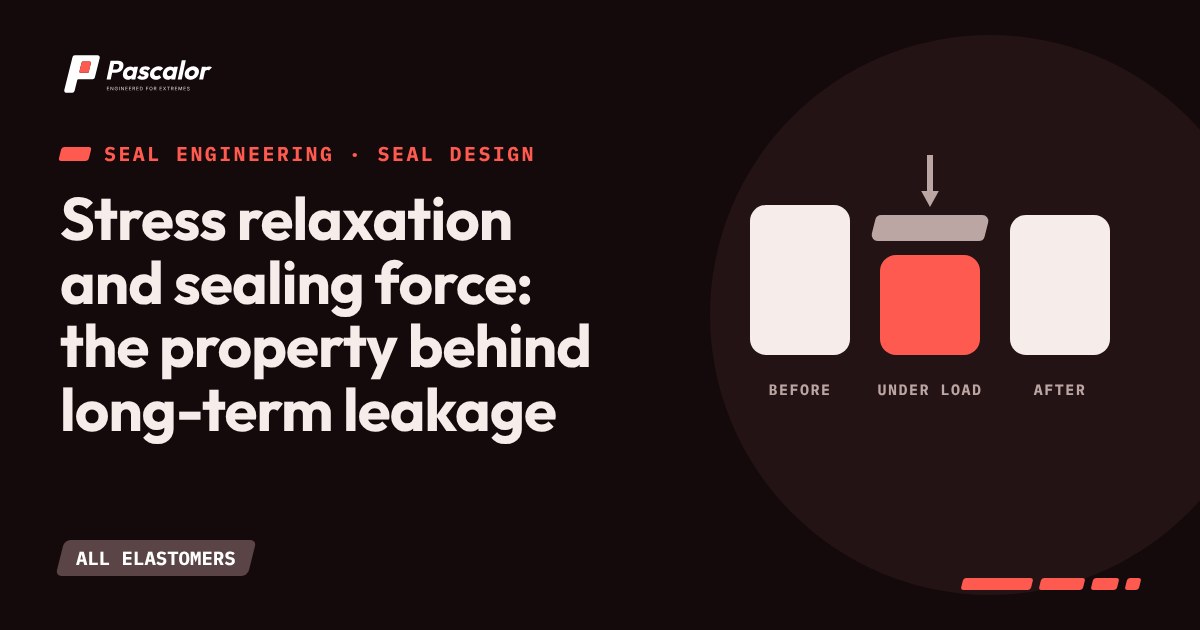
When rubber is held compressed, its chains slowly rearrange and break. Two things follow:
- Force falls (stress relaxation): the contact force on the sealing faces decays.
- Shape is lost (compression set): after release, the rubber does not return fully.
Both reflect the same chemistry, but force decay is what keeps the seal tight in service, because the seal is never released.
Compression stress relaxation (CSR)
A specimen is held compressed at constant strain at temperature and the force is measured over time. The result is normalised, F(t)/F(0). Test methods include ISO 3384 (continuous and intermittent measurement) and ASTM D6147 (force decay of rubber).
A common acceptance: force remaining above 50 percent at the end of life, or whatever the pressure demands.
Why it matters
Seal contact stress needs to stay above the fluid pressure with margin. If initial contact stress is 2.0 times the pressure and CSR retains 40 percent, contact stress is 0.8 times pressure and the seal leaks. Choosing a compound with better CSR, or a design with higher initial squeeze, restores the margin.
Continuous versus intermittent
Continuous relaxation keeps the sample compressed throughout. Intermittent testing releases the load for measurement and gives a different (higher) value because it separates the physical and chemical parts. Know which method was used.
Design translation
- Estimate the minimum contact force needed (fluid pressure plus margin).
- Obtain CSR curves for candidate compounds at service temperature.
- Compute initial force from squeeze and modulus.
- Check that retained force exceeds the requirement at the planned life.
- Increase squeeze or switch compound if it does not.
Data you can request
CSR at two or three temperatures for 1,000 to 10,000 hours, in air and, where relevant, in the fluid. It is the nearest laboratory measure to long-term sealing performance.