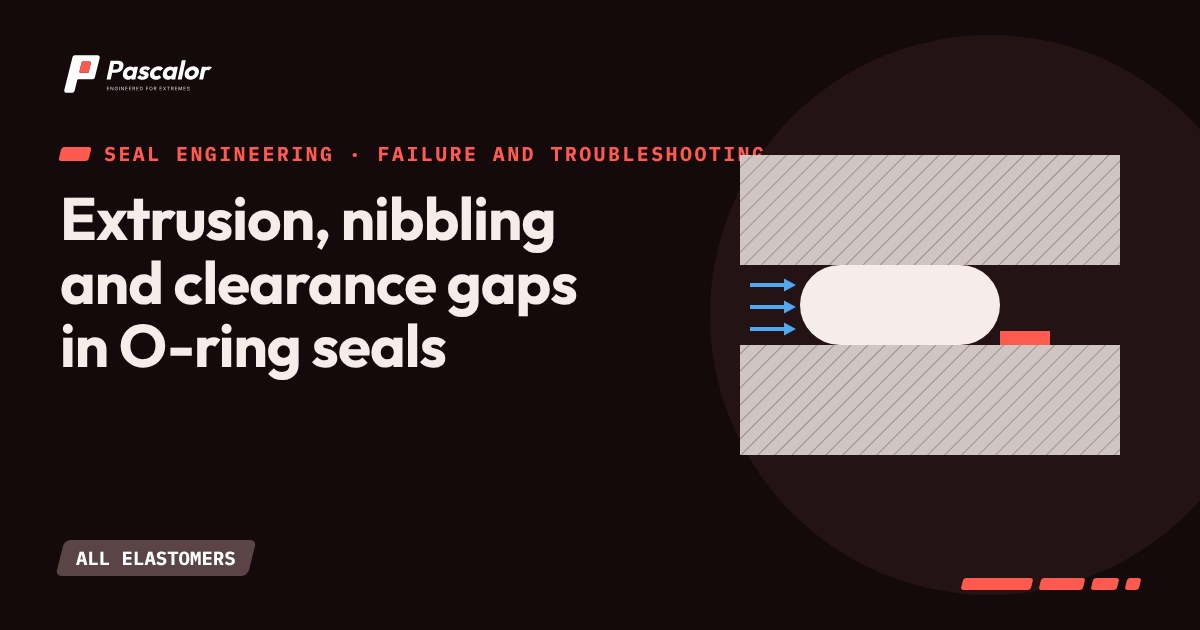
What happens
Under pressure, rubber flows into the clearance between the hardware pieces. Each time pressure cycles, small pieces are nipped off, leaving a ragged, chewed edge on the low-pressure side of the ring (nibbling). Eventually the ring leaks.
What increases risk
- Pressure above about 10 MPa with 70 Shore A rubber.
- Large diametral clearance (worse at the extremes of tolerance).
- Elastic expansion of the housing under pressure, which widens the gap.
- Soft rubber, or rubber softened by fluid swell or temperature.
- Pulsing pressure.
- Eccentric loading or side load.
Extrusion limit rule of thumb
The permissible clearance falls as pressure rises and as hardness drops. At 70 Shore A the gap that can be tolerated at 10 MPa is small, of the order of 0.1 to 0.15 mm total diametral. At 90 Shore A the same pressure allows a clearance two to three times larger. Use the ring maker's chart for your pressure, hardness and dynamic or static duty.
Fixes in order of cost
- Reduce the clearance (tighter tolerance, better concentricity, stiffer housing).
- Increase hardness (80 or 90 Shore A).
- Fit a back-up ring on the low-pressure side.
- Change to a harder or higher-modulus compound.
- Use a PTFE-based seal, or a metal back-up, for extreme pressure.
Recognising the failure
- Ragged or feathered edge on one side of the ring.
- Small pieces in the fluid.
- Wear mark pattern on the low-pressure side.
Distinguish from other failures
Extrusion shows on the low-pressure face. Abrasion shows a flat worn band on the dynamic face. Compression set shows a flat section, with no tearing. Explosive decompression shows internal blisters and cracks.
Test
A pulsed-pressure test at maximum temperature and the worst tolerance stack reproduces the failure quickly. Run it before approving a design for high-pressure service.