Looking at the failed ring is the quickest route to the cause.
| Failure | What you see | Likely cause | Fix |
|---|---|---|---|
| Compression set | Flat, permanently deformed section, no tears | Too much heat, wrong polymer, insufficient cure, overfilled groove | Better compound, lower temperature, correct groove |
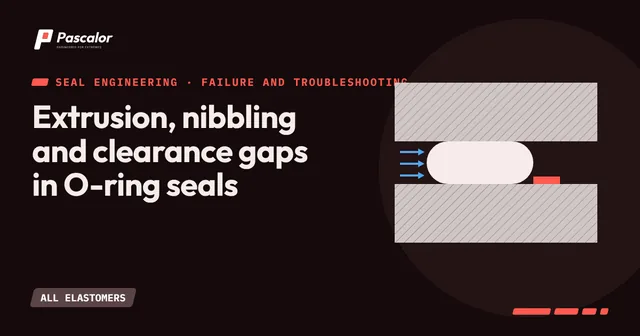
| Extrusion | Ragged edge on the low-pressure side | Gap too large, pressure too high, rubber too soft | Back-up ring, harder compound, smaller gap |
| Spiral failure | Twisted spiral cuts around the ring | Rough surface, long stroke, side load, wrong groove | Quad ring, better finish, lower friction |
| Abrasion | Flat shiny worn area on the dynamic face | Rough surface, dirt, poor lubrication | Fine finish, filters, compatible lubricant |
| Thermal degradation | Cracks, hardening, surface crazing, brittleness | Temperature too high | Higher grade polymer |
| Chemical attack | Swelling, softening, shrinkage, loss of weight | Fluid not compatible | Change polymer after a compatibility test |
| Installation damage | Cuts, nicks, twisted ring | Sharp edges, tools, dirt | Chamfers, lubricant, installation tool, assembly training |
| Explosive decompression | Blisters, internal splits, pocks | Gas dissolved at pressure expands when pressure drops | Use RGD-resistant compound, harder, tougher, vented design |
| Ozone cracking | Fine surface cracks at stressed zones | Ozone on susceptible rubber | EPDM, FKM or antiozonant compound |
| Plasticiser extraction | Shrinkage, hardening in service | Fluid pulls out plasticiser | Plasticiser-free compound |
How to investigate
- Photograph the ring as received, before cleaning.
- Note where on the ring and which side of the gland the damage is.
- Measure cross-section, hardness and weight against the new part.
- Check the groove and shaft for wear, burrs and finish.
- Review fluid, temperature and pressure history, especially upsets.
- Cut a section to see internal damage.
Root cause thinking
Many rings fail from a combination: a ring with marginal compression set in a groove that was a little too deep, at a temperature 20 degrees above design. Fix the margin, not only the symptom.
Records
Keep the failed ring and the lot number. Lot traceability lets you separate a material problem from a design problem.
About this article. It is original writing prepared from public sources, standards and general industry practice. It is not a copy of any book or standard and it is not engineering advice. Confirm values against the current edition of the standard and test in your own application. Only analyse material you own or are entitled to analyse.