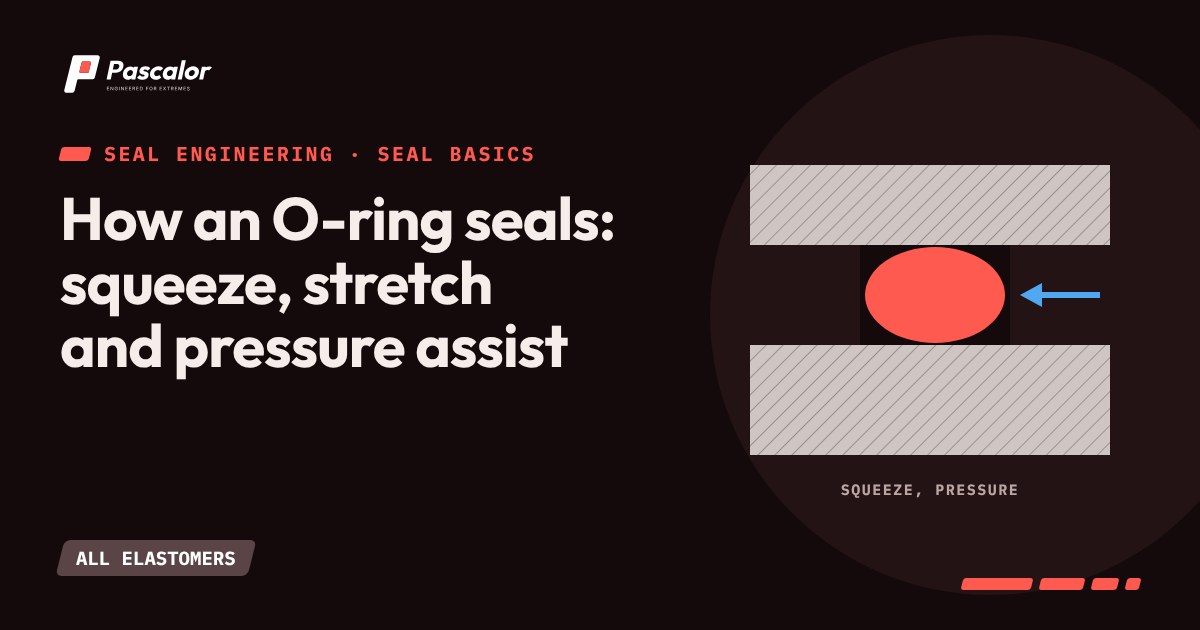
An O-ring is a torus of rubber placed in a groove. It seals because the rubber is squeezed between two surfaces and tries to push back.
Three sources of sealing force
- Squeeze. Compressing the cross section by 15 to 30 percent creates the initial contact stress. This is what seals at zero pressure.
- Stretch. Fitting the ring on a rod or in a bore stretches or compresses its diameter and adds a little force. Keep stretch below about 5 percent for long life.
- Pressure. Fluid pressure pushes the rubber against the low-pressure wall and surface. Because rubber is almost incompressible, contact stress rises with pressure, which is why O-rings seal better the harder they are pushed (until extrusion).
Why it works for static and dynamic cases
In a static seal nothing moves, so squeeze may be high and friction does not matter. In a dynamic seal the ring slides, so squeeze is lower to reduce friction and heat, and surface finish matters much more.
Contact stress must exceed fluid pressure
A seal leaks when fluid pressure is larger than the contact stress at any point. Contact stress comes from squeeze, rubber hardness and pressure. Soft rubber with low squeeze may fail at low pressure. Hard rubber with generous squeeze seals higher pressure but needs more assembly force and may crack at low temperature.
What the groove does
- Gives the rubber a place to be squeezed.
- Leaves a void (about 15 to 40 percent of the groove) so rubber can expand with temperature or swell.
- Holds the ring in place.
- Defines the clearance gap through which the rubber may extrude.
The compression set limit
After long service the rubber takes a permanent set and loses push-back. Seal life ends when the remaining recovery cannot keep contact stress above the fluid pressure. Compression set is therefore the single most important elastomer property for static O-rings. See the compression set article.
Common mistakes
- Squeeze too low to cover tolerance stack.
- Groove completely filled so thermal growth cannot be absorbed.
- Pinching on assembly.
- Rough or damaged sealing faces.
- Ignoring swell or shrinkage in the fluid.