Laboratory mixers have a small batch, a large surface-to-volume ratio and excellent cooling. Production mixers have a large batch, less cooling per kilogram and more heat build-up. A recipe that mixed beautifully in the lab can scorch or under-disperse at scale.
What changes
- Heat removal. Heat generation scales with volume, cooling with surface. Production batches run hotter for the same cycle.
- Mixing intensity. Rotor tip speed, fill factor, clearance and ram load are not geometrically identical in different sizes.
- Raw material form. Large bales or bags, different moisture and different temperature than a lab sample.
- Cooling and handling. Big batches cool slowly after dump, so cure reactions continue in the stack.
A scaling method
- Match specific energy. Measure the energy per kilogram needed in the lab mixer to reach the target dispersion and viscosity. Aim for the same specific energy at scale.
- Match temperature history. Keep the same peak temperature and time above a critical temperature. Slower production cooling means you may need lower speed or shorter stages.
- Match fill factor as a fraction of free volume, not batch weight.
- Use staged mixing to hold temperature. Split a long cycle into two shorter passes with a cooling step.
- Validate with the same tests: rheometer, Mooney, density, dispersion rating, and cured properties.
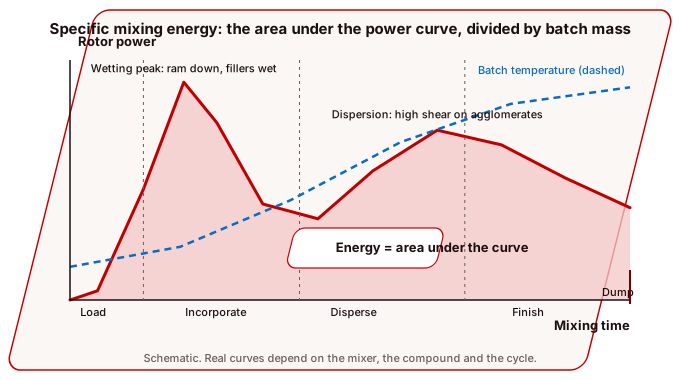 Figure. Mixing power and specific energy. The area under the power curve, divided by the batch mass, is the specific energy put in.
What to watch for
- Scorch: ts2 shorter than in the lab. Lower dump temperature, use a more stable peroxide or a cooler final stage.
- Poorer dispersion: raise energy input, adjust ram pressure, change sequence.
- Bound rubber or viscosity differences: sign of different filler-polymer interaction history.
Documentation
For every scale-up, record the lab and production parameters side by side and the test results. That record becomes the starting point for the next compound.
About this article. It is original writing prepared from public sources, standards and general industry practice. It is not a copy of any book or standard and it is not engineering advice. Confirm values against the current edition of the standard and test in your own application. Only analyse material you own or are entitled to analyse.