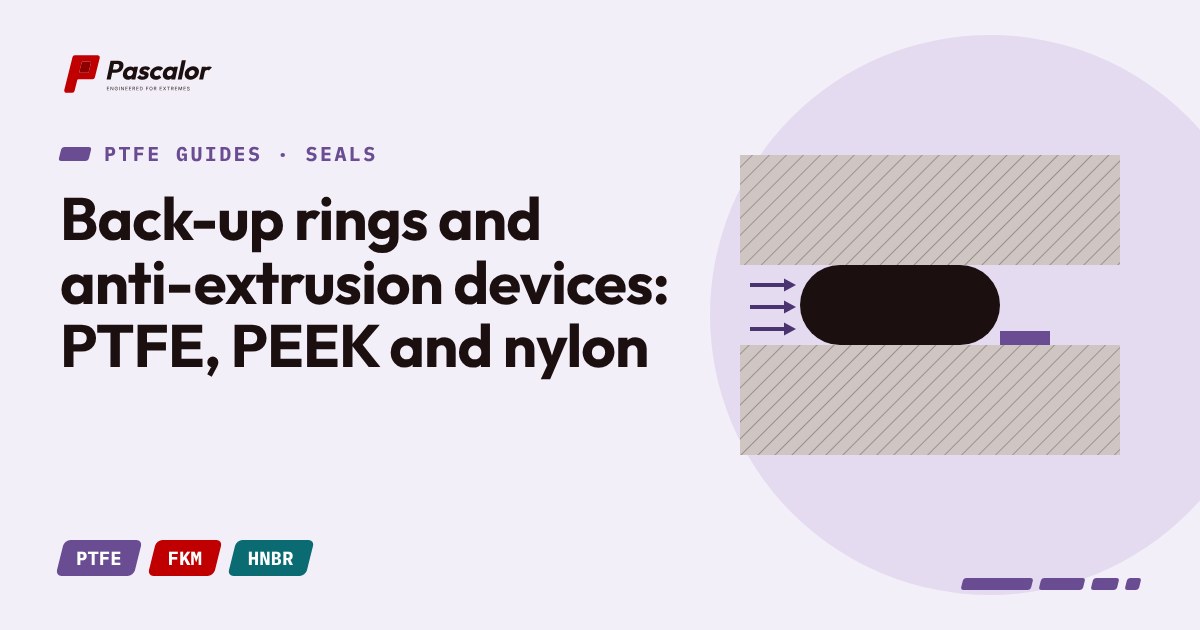
An elastomer under pressure behaves like a very viscous fluid. If a clearance gap exists, rubber flows into it and is nibbled or cut. A back-up ring fills the gap on the low-pressure side of the seal.
When you need one
- Pressure above roughly 10 MPa (1,500 psi) in static or dynamic O-ring seals with normal clearance and 70 Shore A rubber.
- Lower pressure when the clearance is large, the rubber is soft, the temperature is high, or the pressure pulses.
- Hardness 90 Shore A rubber can handle higher pressure but still benefits from back-up in dynamic duty.
Geometry
| Type | Description | Notes |
|---|---|---|
| Solid (flat or turned) | A ring with a rectangular section | Best if the groove is split or the ring can be stretched in |
| Spiral | A wound strip | Easy fitting, needs well-finished gland |
| Scarf-cut (split) | A diagonal cut ring | Easy to install but the joint opens under pressure |
| Concave | Shaped to cup the O-ring | Better seat for the rubber, a good choice for dynamic duty |
One back-up on the low-pressure side for one-way pressure. Two for reversing pressure.
Materials
| Material | Strength | Limits |
|---|---|---|
| PTFE (virgin) | Wide chemical range | Creeps at high pressure |
| Filled PTFE (glass, carbon, bronze) | Better creep, wear | Counterface abrasion for glass |
| Nylon | Hard, cheap | Hydrolyses in hot water, low temperature limit |
| PEEK | Very strong, up to about 250 degrees C | Cost, less conformable |
| Polyimide | High temperature | Brittle, costly |
| Metal | Extreme pressure | Needs precise machining |
Clearance and extrusion
Allowable extrusion gap decreases with pressure and softer rubber. At 10 MPa with 70 Shore A rubber the gap should be a small fraction of a millimetre. Always use diametral clearance at the worst-case tolerance stack, including pressure-induced elastic growth of the housing.
Common errors
- Fitting the back-up on the pressure side.
- Using a rigid back-up in a tight groove with no allowance for thermal expansion.
- Cutting spiral ring ends square so they lock.
- Using nylon back-ups in hot water or glycol.
Verification
Test at pressure and temperature with pulsing. Cut up the seal and look for nibbling, a sign the gap or hardness is wrong.
About this article. It is original writing prepared from public sources, standards and general industry practice. It is not a copy of any book or standard and it is not engineering advice. Confirm values against the current edition of the standard and test in your own application. Only analyse material you own or are entitled to analyse.