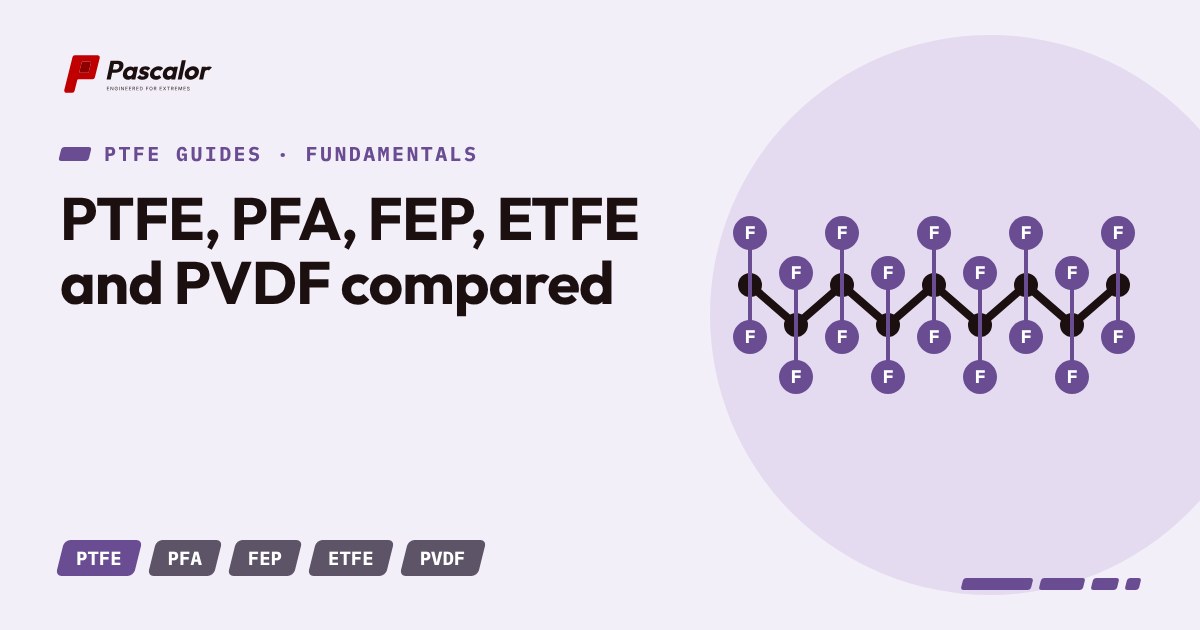
PTFE gets the attention, but several relatives are easier to process or cheaper and fit particular jobs.
| Polymer | Continuous use (approx) | Processing | Strengths | Limits |
|---|---|---|---|---|
| PTFE | to about 260 degrees C | Sintered, not melt-processable | Widest chemical and temperature range, lowest friction | Creep, cannot be injection moulded |
| PFA | to about 260 degrees C | Melt-processable | PTFE-like resistance in injection-moulded and extruded shapes, high purity | Higher cost, still creeps |
| FEP | to about 200 degrees C | Melt-processable | Transparent, easy to weld, good for encapsulation and thin liners | Lower temperature limit |
| ETFE | to about 150 degrees C | Melt-processable | Tougher, higher strength, radiation resistant | Lower chemical and temperature range |
| PVDF | to about 130-150 degrees C | Melt-processable | Strong, rigid, good against halogens and acids | Limited in strong bases, lower temperature |
| ECTFE | to about 150 degrees C | Melt-processable | Excellent barrier, tough | Moderate temperature |
Where each shows up in sealing and lining
- PTFE: seals, gaskets, bearings, liners, valve seats.
- PFA: semiconductor tubing, valve bodies, thin liners, encapsulation.
- FEP: encapsulated O-ring jackets, heat-shrink, wire.
- ETFE: cable insulation, pump parts, films.
- PVDF: pipes, fittings, membranes.
Sealing implications
Melt-processable fluoropolymers can be injection moulded into complex shapes, but all of them are stiffer than rubber and creep under load. They are used as jackets, liners or components, not as direct replacements for elastomers except in low-deflection static roles.
Engineering thermoplastics beside them
PEEK, polyimide, PPS and UHMWPE appear in back-up rings, wear bands and seat inserts. They are not fluoropolymers, so they avoid the PFAS question, but each has its own chemical and temperature limits. Choose with the fluid and counterface in mind.
Rule of thumb
Use PTFE for the hardest chemistry or temperature, PFA when you need injection moulding and purity, FEP when you need transparency or welding, and ETFE or PVDF when strength and cost matter more than the last 50 degrees.