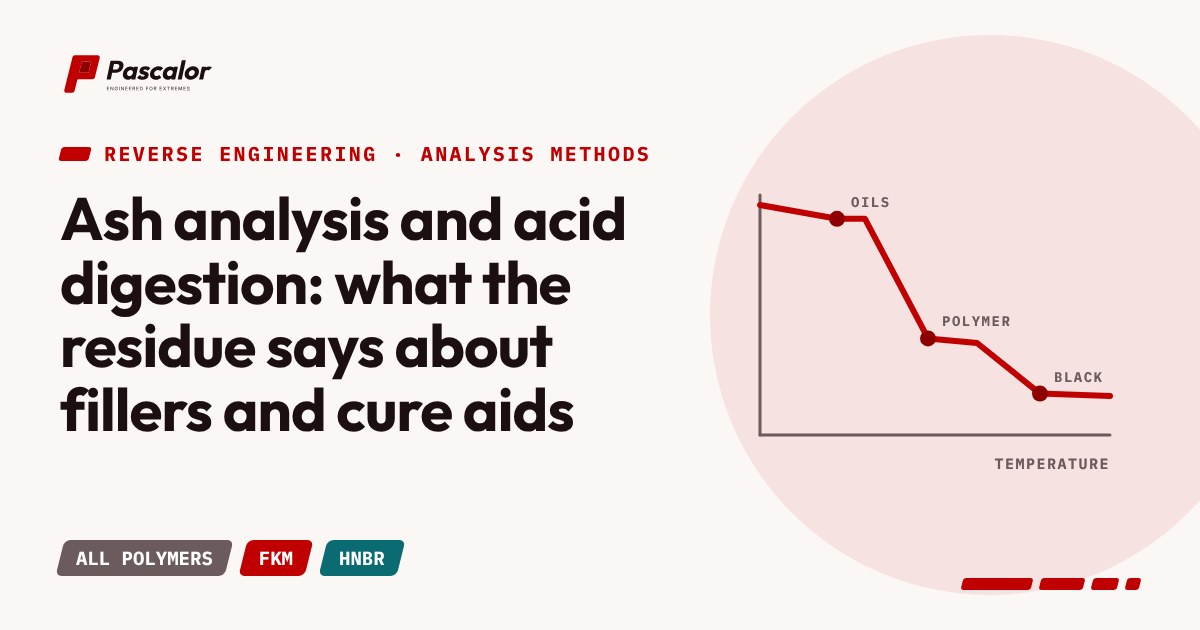
After the polymer, oil and carbon black are gone, the ash is the inorganic fingerprint of the compound. It is where the mineral fillers and the metal oxide cure aids end up. A careful ash analysis is the difference between "some white filler" and a specific list of ingredients.
Making the ash
Heat a weighed sample in air at high temperature, often in the range of 550 to 900 °C depending on the method, until all organic matter and carbon are burned. Weigh the residue. Some methods burn the sample directly in a muffle furnace, others take the ash from the TGA residue.
Successive acid treatments
The ash is treated with acids in stages, and the part that dissolves is separated from the part that does not.
- Hydrochloric acid dissolves zinc oxide, magnesium oxide, calcium oxide and carbonates, and some other metal compounds.
- The insoluble residue contains silica, silicates, clays, titanium dioxide and barium sulfate.
- Further treatments with stronger acids or fusion methods open up what remains.
Each fraction is weighed and analysed.
What to measure in the solutions
Atomic absorption spectroscopy (AAS) or inductively coupled plasma (ICP) gives the amount of each metal: zinc, calcium, magnesium, barium, aluminium, iron, lead and so on. See AAS and ICP for rubber. Infrared or X-ray methods identify the insoluble solids.
Turning metals into ingredients
| Finding | Likely ingredient |
|---|---|
| Zinc | zinc oxide, or a zinc soap or accelerator |
| Magnesium | magnesium oxide, magnesium hydroxide or carbonate |
| Calcium | calcium carbonate, calcium hydroxide, calcium oxide |
| Silicon with aluminium | clay or silicate |
| Silicon alone | silica (precipitated or fumed) |
| Titanium | titanium dioxide, a white or coloured pigment |
| Barium | barium sulfate or barytes |
| Lead | lead oxide or red lead in specialist cures |
Traps
- Chemistry changes in the furnace. Zinc oxide can react with sulfur and halogens, and with fluorine to form zinc fluoride. Magnesium and calcium compounds in fluoroelastomers partly end up as fluorides after cure and burn, which changes the weight balance. The reconstruction has to correct for this.
- Total ash is not total filler. Some inorganic material volatilises, and some carbonates lose weight during ashing.
- Do not double count. A compound with 3 phr magnesium oxide and 6 phr calcium hydroxide is not a heavily mineral-filled compound. Those are acid acceptors and cure aids.