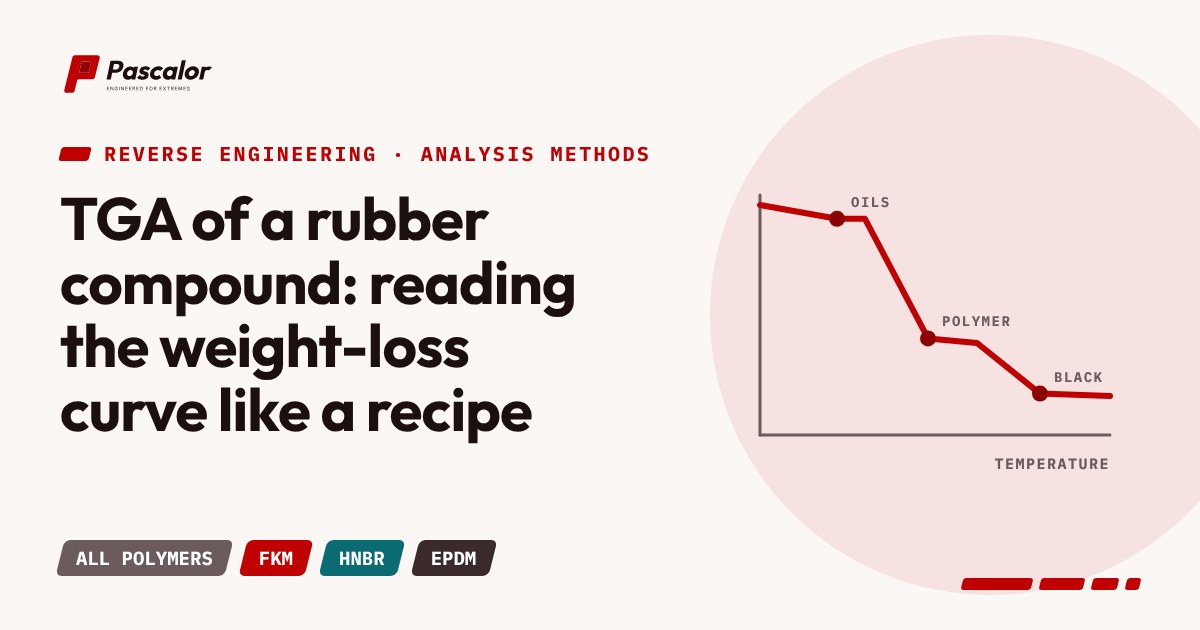
Thermogravimetric analysis (TGA) weighs a few milligrams of sample while heating it on a controlled programme. The loss of weight is recorded against temperature. For a rubber compound the curve is a quick, quantitative picture of what is inside.
The standard programme
- Inert atmosphere (nitrogen), ramp to about 550 to 600 °C. Moisture and light volatiles leave first, then the oils and other low-molecular-weight organics, then the polymer pyrolyses into volatile fragments.
- Hold or cool slightly, then switch to air or oxygen and heat to about 750 to 800 °C. Carbon black and any char burn off.
- What remains is ash, which is the mineral filler and metal oxides.
Reading the steps
| Step | Typical temperature region | What is leaving |
|---|---|---|
| 1 | below about 200 °C | water, light volatiles, some low molecular weight processing aids |
| 2 | about 200 to 350 °C | oils, plasticisers, waxes, some additives |
| 3 | about 350 to 550 °C | polymer decomposition (the position and shape depend on the polymer) |
| 4 | in air, about 550 to 750 °C | carbon black and char oxidation |
| residue | ash: silica, clay, zinc oxide, calcium and magnesium compounds |
Temperatures shift with the polymer and heating rate. The position of the polymer step is itself a clue: natural rubber, SBR, nitrile and EPDM each decompose in slightly different ranges, and fluoroelastomers are far more thermally stable than hydrocarbon rubbers.
Three traps
- Overlapping steps. Oils that boil in the same range as polymer breakdown, or a blend of two polymers, give a merged step. Running the extraction first and TGA on the extracted sample separates them.
- Carbonates and hydroxides. Calcium carbonate loses carbon dioxide at high temperature and calcium hydroxide loses water. Both create weight loss that can be mistaken for carbon black or volatile loss. In fluoroelastomer compounds with calcium hydroxide and magnesium oxide, this matters.
- Char and residues from halogenated polymers. Chlorinated and fluorinated polymers can leave carbonaceous residue and release corrosive gases. Fluoroelastomer analysis needs equipment and ventilation suited to hydrogen fluoride.
What to extract from the result
- Volatiles and extractables, in per cent.
- Polymer (rubber hydrocarbon) content, in per cent.
- Carbon black content, in per cent.
- Ash, in per cent.
Together with the polymer identification and ash composition, these four numbers become phr values in the reconstruction. See the worked arithmetic in From weight percent to phr.
Sources and further reading
- ASTM D6370, rubber: compositional analysis by thermogravimetry.
- ISO 9924-1 and ISO 9924-2, thermogravimetry of vulcanizates and uncured rubbers.
About this article. It is original writing prepared from public sources, standards and general industry practice. It is not a copy of any book or standard and it is not engineering advice. Confirm values against the current edition of the standard and test in your own application. Only analyse material you own or are entitled to analyse.