A cured rubber is a network. The number of crosslinks controls modulus, hardness, set and swell. Because the network cannot be dissolved, it is probed by swelling.
The principle
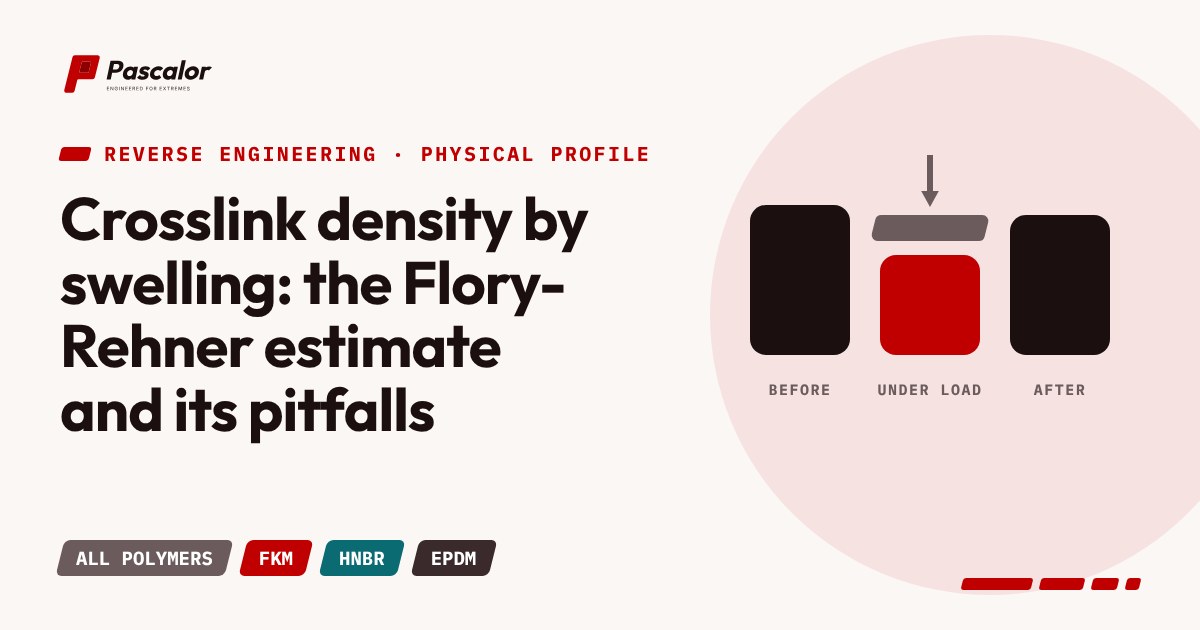
A weighed piece is immersed in a good solvent until it reaches equilibrium swelling. The more crosslinks, the less the network can expand. The classical Flory–Rehner equation relates the volume fraction of polymer in the swollen gel to the crosslink density, using a polymer-solvent interaction parameter.
The practical test
- Weigh a small piece of the cured sample and measure its volume.
- Immerse it in solvent at constant temperature until the weight stops changing, which can take days.
- Weigh the swollen sample, then dry and weigh again to account for extractables.
- Compute the volume fraction of polymer in the swollen network and apply the equation with an interaction parameter for that polymer and solvent.
The pitfalls
- Filler. Fillers that bond to the rubber restrict swelling and appear as extra crosslinks. Corrections such as the Kraus relation exist, but the result is still approximate.
- The interaction parameter depends on the polymer-solvent pair, and the literature values vary.
- Extractables and sol fraction must be removed or measured.
- Polymers that do not swell well in common solvents, such as fluoroelastomers and silicones, need special solvents.
- Non-network effects such as chain entanglements and dangling chain ends add error.
How to use it
Use swelling for comparison: original versus trial compound, same solvent, same procedure. If the two give similar swelling ratios, their networks are similar. Pair with the rheometer curve and the compression set. The absolute crosslink density number is useful as an order of magnitude, but not as a specification.
Sources and further reading
- P. J. Flory and J. Rehner, Journal of Chemical Physics (1943). The classical network swelling theory.