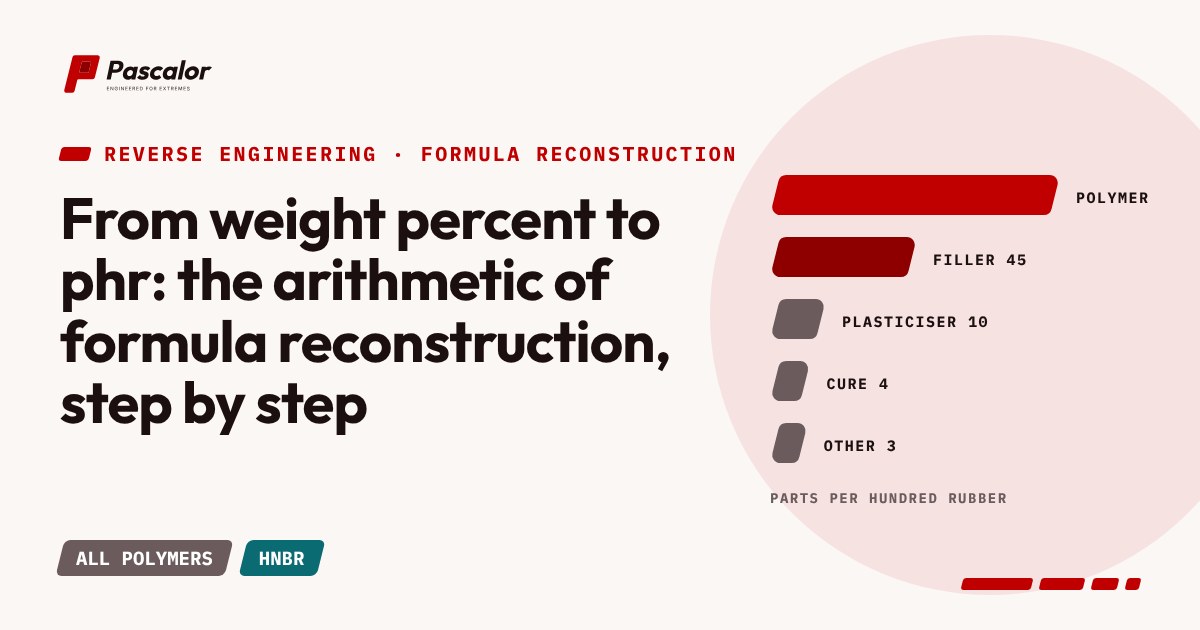
Every analysis ends with a table of weight percentages. Every recipe is written in phr, parts per hundred parts of rubber. Converting one into the other is simple arithmetic, but the order of the steps and the sanity checks are what make a reconstruction credible.
The rule
Take the polymer (the rubber hydrocarbon, or in a fluoroelastomer the fluoropolymer) as 100. Divide every other fraction by the polymer fraction and multiply by 100.
A worked example (invented numbers)
An HNBR seal gives these results.
| Result | Weight % |
|---|---|
| Acetone extract (oil, plasticiser, antioxidant) | 4.0 |
| Polymer (from TGA and polymer identification) | 60.0 |
| Carbon black (from TGA, burn-off in air) | 30.0 |
| Ash | 6.0 |
| Total | 100.0 |
Ash analysis by acid digestion and ICP shows that all of the ash dissolves in hydrochloric acid and the metals found are zinc and magnesium in a ratio equivalent to 4.0 % zinc oxide and 2.0 % magnesium oxide.
Step 1: scale to polymer = 100
The multiplier is 100 ÷ 60.0 = 1.667.
| Ingredient | % in compound | phr |
|---|---|---|
| HNBR | 60.0 | 100.0 |
| Carbon black | 30.0 | 50.0 |
| Zinc oxide | 4.0 | 6.7 |
| Magnesium oxide | 2.0 | 3.3 |
| Extractables | 4.0 | 6.7 |
| Total | 100.0 | 166.7 |
Step 2: split the extractables
Gas chromatography with mass spectrometry shows the extract is an ester plasticiser (about 5 phr) and an amine antioxidant plus a small amount of stearic acid (about 1.7 phr together). The curative, a peroxide with a coagent, is mostly consumed in cure, so it is estimated from knowledge of typical recipes: 6 phr of a 40 % active peroxide and 2 phr of coagent are common starting points, which the cure curve will confirm.
Step 3: reconcile with the physical profile
Hardness 75 Shore A and a density near 1.2 g/cm³ should fit the proposed recipe. Calculate the density from the recipe: sum the masses and divide by the sum of mass ÷ density for each ingredient. If the calculated density is 3 % off the measured value, something is wrong: a mineral filler is missing, or the black is mis-estimated.
Checks that catch mistakes
- Total must be about 100 %. If your fractions add up to 96 %, something is unaccounted for. Moisture, carbon dioxide from carbonates and fluorides are usual culprits.
- Ash cannot exceed what the metals explain. If ash is 6.0 % but zinc and magnesium oxides explain only 3.5 %, find the other 2.5 %.
- Black plus ash plus polymer plus extract equals sample weight. If your TGA total does not match your extraction total, the sample was not homogeneous.
- Recipes are rounded by humans. Compounders do not use 6.7 phr zinc oxide. They use 5 or 6 or 7. Round to the nearest sensible figure.
Sources and further reading
- The method follows ASTM D297 style compositional analysis. The numbers below are invented for teaching and do not describe any real product.