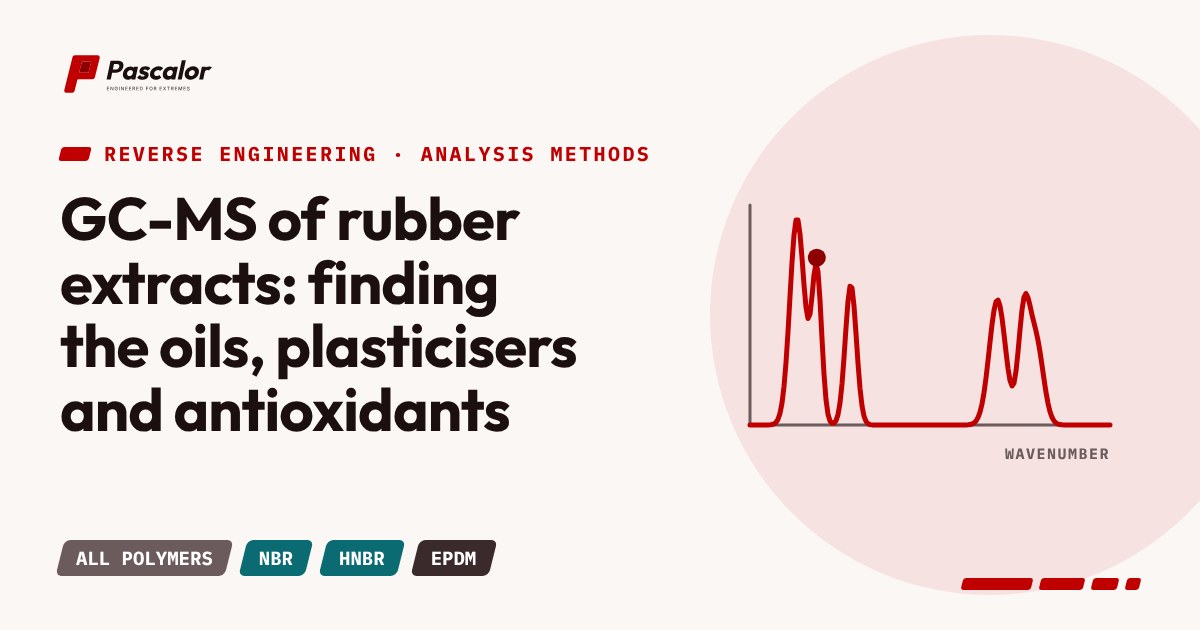
After extraction the organic fraction of a rubber compound is a mixture of oils, plasticisers, waxes, antioxidants and curative residues. Gas chromatography with mass spectrometry (GC-MS) separates the mixture and identifies the components by their mass spectra.
How it works
- A small volume of the extract solution is vaporised in the injector.
- A carrier gas moves it through a long column. Compounds leave the column at different times depending on volatility and polarity.
- A mass spectrometer fragments each compound and records a pattern. The pattern is matched against a spectral library and verified against standards.
What it finds well
- Hydrocarbon process oils. Paraffinic, naphthenic and aromatic oils give recognisable hump-shaped distributions rather than single peaks.
- Ester plasticisers such as adipates, sebacates, phthalates and trimellitates, which matter in nitrile and HNBR for low-temperature flexibility.
- Fatty acids and waxes, including stearic acid and paraffin waxes.
- Many antioxidants and antiozonants, including phenolic and amine types.
- Some accelerator fragments and their by-products.
What it can miss
- High molecular weight resins and polymeric plasticisers that do not elute.
- Very polar or ionic compounds such as zinc salts.
- Thermally unstable compounds that break down in the hot injector. Liquid chromatography is the alternative.
- Anything not extracted by the chosen solvent.
From peaks to phr
Peak areas depend on how each compound responds in the detector. For a semi-quantitative estimate:
- Calibrate with standards of the main components if you can obtain them.
- Distribute the weighed extract mass among the identified components in proportion to their corrected peak areas.
- Express the result as phr against the polymer fraction.
Treat a split such as "oil 55 %, antioxidant 20 %, wax 10 %, other 15 %" as accurate to a few percentage points at best.
Why it matters for low temperature
In HNBR and nitrile compounds, the choice and level of plasticiser strongly affects cold flexibility and fluid extraction in service. A seal that stays flexible only because of a volatile ester will stiffen as the plasticiser migrates out. GC-MS makes that visible, which is why extract analysis is part of any HPLT benchmark.