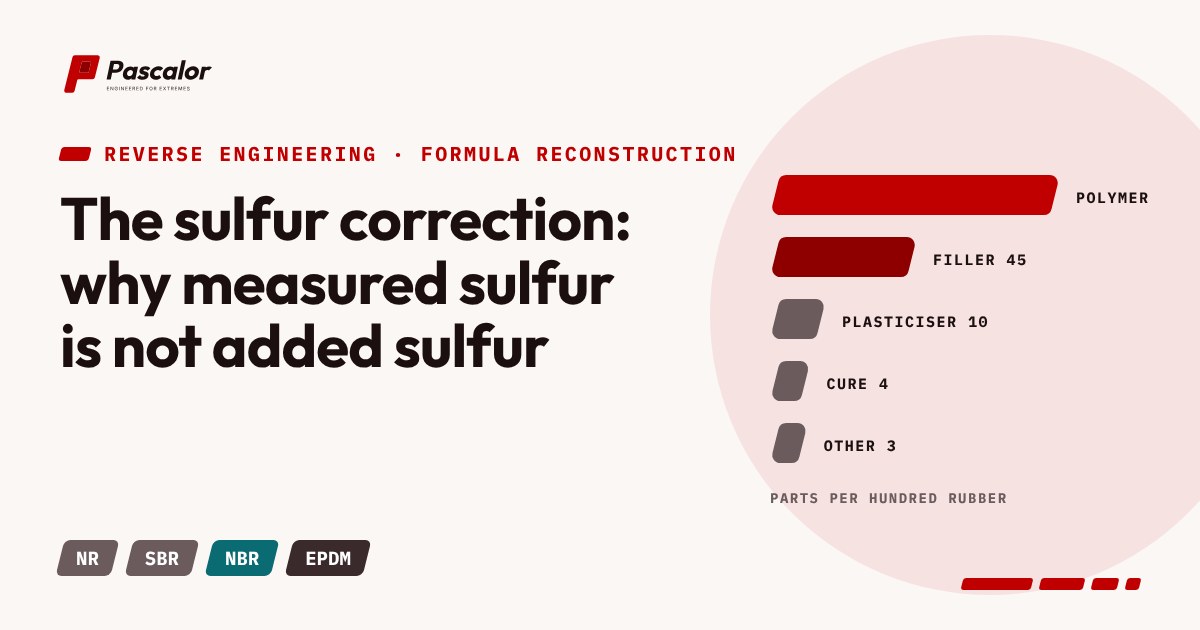
In a sulfur-cured rubber, an elemental analyser (often a combustion method) gives total sulfur. It is tempting to convert that straight into phr of sulfur powder. It will almost always overstate the added sulfur.
Where else the sulfur comes from
- Accelerators. Most accelerator families (sulfenamides, thiazoles, thiurams, dithiocarbamates) contain sulfur. A thiuram at 1 phr and a sulfenamide at 1.5 phr can together add the equivalent of a few tenths of a phr of sulfur.
- Sulfur donors. Compounds that release sulfur during cure, such as certain thiuram disulfides and dithiomorpholine, are added in place of or alongside elemental sulfur.
- Carbon black. Furnace blacks carry a small percentage of sulfur on the surface, usually below one per cent, but at 50 phr of black that is not negligible.
- Antioxidants and processing aids. Some contain sulfur (mercapto benzimidazoles, thioesters).
- Polymer. Sulfur-modified chloroprene and polysulfide elastomers carry sulfur in the polymer itself.
A method that works in practice
- Convert measured total sulfur from weight percent of compound to phr of polymer using the standard rule. Call it S_total.
- Estimate the sulfur contribution of each identified accelerator and antioxidant from its formula and likely loading.
- Estimate the sulfur contribution from the black using typical sulfur content for the identified grade family.
- Subtract steps 2 and 3 from S_total. What remains is the best estimate of elemental or donor sulfur.
- Sanity-check against the cure system type. A "semi-efficient" system with plenty of accelerator has low sulfur, an "conventional" system has high sulfur and low accelerator. The accelerator-to-sulfur ratio should make sense.
A short illustration with invented numbers
Total sulfur is found at 2.4 phr. The extract shows a sulfenamide (about 1.5 phr, containing roughly 0.2 phr sulfur) and a thiuram (about 0.3 phr, roughly 0.1 phr sulfur). The black contributes about 0.3 phr. Subtracting leaves 1.8 phr, which is a sensible conventional-type sulfur level.
When you can skip it
- Peroxide-cured compounds (HNBR, EPDM, FEPM, most FKM) should contain almost no added sulfur, so any sulfur found is from fillers or additives. Use it as a clue, not a recipe line.
- Compounds where sulfur is not a function of the cure and the reconstruction only needs a family-level description.
Reporting
Always say that sulfur was corrected, and how. A reader seeing "2.4 phr sulfur" in one report and "1.8" in another needs to know why.
About this article. It is original writing prepared from public sources, standards and general industry practice. It is not a copy of any book or standard and it is not engineering advice. Confirm values against the current edition of the standard and test in your own application. Only analyse material you own or are entitled to analyse.