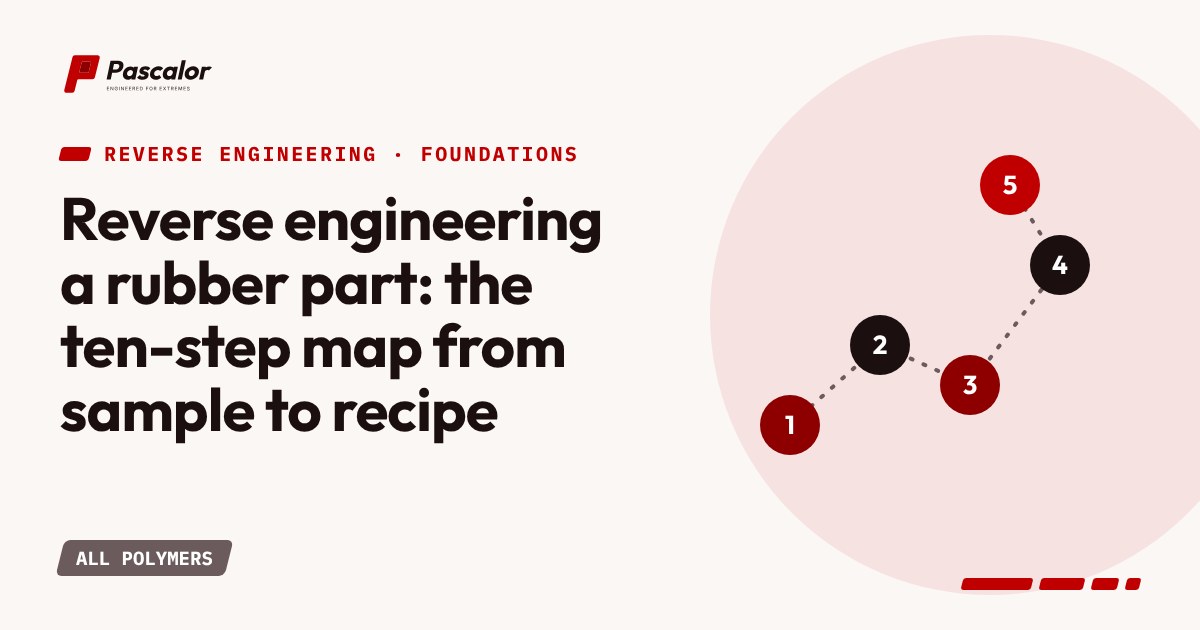
Reverse engineering of rubber is the craft of working backwards from a finished, cured part to an estimate of what went into the mixer. It never recovers the recipe. It produces a reasoned reconstruction that can be mixed, cured, tested and adjusted until it behaves like the original. This article is the map. Every step has its own article in this library.
The ten steps
- Define the goal. Benchmarking a competitor, qualifying a second source, finding out why a seal failed, or simply documenting an old part with no paperwork. The goal decides how deep to go and what accuracy is worth paying for.
- Collect and record the sample. Where did it come from, what duty did it see, how old is it? A used part tells you about ageing as well as composition.
- Non-destructive checks. Dimensions, hardness, density, colour, surface finish, markings. These cost almost nothing and already narrow the field.
- Prepare a homogeneous sample. Remove metal, fabric, paint and flash. Cut or mill to small, representative pieces. A poor sample ruins every later number.
- Extraction. A solvent such as acetone pulls out the soluble organics: oils, plasticisers, waxes, some antioxidants and unreacted curatives. Weigh what comes out and analyse it separately.
- Thermogravimetry (TGA). Heating in an inert gas and then in air separates volatiles, polymer, carbon black and ash into weighed fractions.
- Polymer identification. Infrared spectroscopy, pyrolysis methods and thermal analysis, ideally two independent routes that agree.
- Ash and element analysis. What is left after burning tells you the mineral filler and the metal oxides. Elemental tests find sulfur, fluorine, chlorine, silicon and more.
- Reconstruction. Convert weight fractions to parts per hundred of rubber (phr) and fill the gaps using knowledge of how compounders actually work.
- Trial mix and comparison. Mix, cure and test the candidate against the original on the same properties. Adjust and repeat.
Where it goes wrong
- Treating one technique as proof. A single infrared spectrum of a heavily filled sample can suggest the wrong polymer. Two methods that agree are worth far more.
- Skipping the physical profile. A reconstruction that matches the chemistry but not the hardness, modulus and compression set has not matched anything that matters.
- Chasing curative detail. Accelerators, peroxides and coagents change during cure. Do not spend a week trying to identify what the chemistry itself has consumed. Compare cure curves instead.
What you can honestly deliver
A good report states the polymer family, the filler system, approximate loadings, a property profile to match, and a plain list of what is unknown. That is exactly the shape of the Pascalor Decode report. The rest of this library walks through each technique in turn.
Sources and further reading
- S. Dasgupta, R. Mukhopadhyay, K. C. Baranwal and A. K. Bhowmick, Reverse Engineering of Rubber Products: Concepts, Tools, and Techniques, CRC Press (2014).
- ASTM D297, rubber products: chemical analysis.
- ISO 9924, rubber and rubber products: determination of the composition of vulcanizates and uncured rubbers by thermogravimetry.
About this article. It is original writing prepared from public sources, standards and general industry practice. It is not a copy of any book or standard and it is not engineering advice. Confirm values against the current edition of the standard and test in your own application. Only analyse material you own or are entitled to analyse.