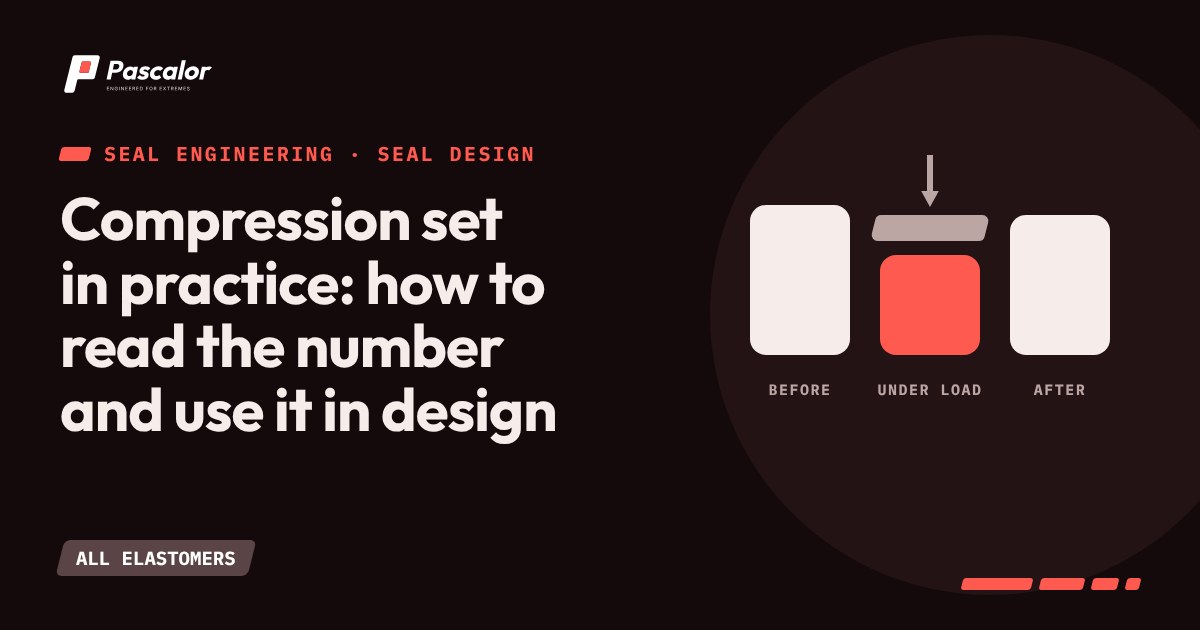
Compression set (CS) is the fraction of imposed squeeze not recovered after the load is released. Lower is better.
The test
A small disc (ASTM D395 Method B uses a button of 29 mm diameter and 12.5 mm thickness) or a cut ring is compressed by 25 percent between plates, aged at a set temperature for a set time, released, left to relax for 30 minutes, then measured. CS percent = (original thickness - final thickness) / (original thickness - compressed thickness) x 100.
Typical conditions: 22 hours at 70 degrees C for NBR, 70 hours at 150 degrees C for HNBR or silicone, 70 hours at 200 degrees C for FKM, 22 hours at 200 degrees C for FEPM or FKM peroxide types. ISO 815 is the equivalent standard.
Why labs disagree
- Sample size and shape (button versus O-ring).
- Fluid exposure (CS in air versus in oil).
- Post-cure state.
- Release time and test temperature accuracy.
- Compression percentage.
Always compare numbers made with the same method.
Reading a value
| CS after test | Meaning |
|---|---|
| Below 15 percent | Excellent, suitable for long static life |
| 15 to 30 percent | Good |
| 30 to 50 percent | Marginal for static, reduce squeeze loss expectation |
| Above 50 percent | Poor, likely to leak as a long-term static seal |
Link to seal life
The seal stops sealing when its recovery cannot follow the gap between surfaces any more. A rough rule: if CS reaches around 80 percent of the original squeeze, leakage is likely. Because CS rises with time and temperature, a 25 percent value after 70 hours is not a promise for 10 years.
What lowers CS
- Proper cure and post-cure.
- Peroxide or bisphenol cure with suitable coagents.
- Low-temperature plasticiser avoidance.
- Appropriate filler loading.
- Choosing the right polymer for the temperature.
Design response
Use enough initial squeeze (15 to 25 percent), keep groove fill under control, avoid hot compression of hard rubber, and pick a compound with CS data at your actual temperature and in your fluid. For long life, request time-temperature data and an Arrhenius extrapolation.