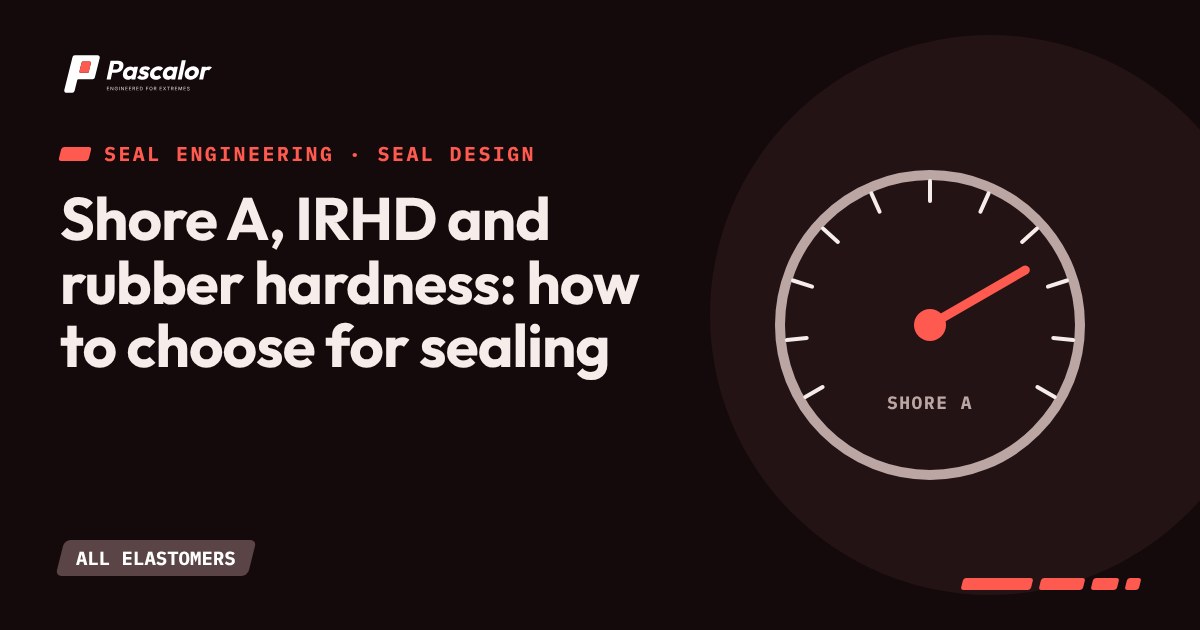
Hardness is resistance to indentation. For rubber it is the quickest quality check and a rough guide to stiffness.
Scales
- Shore A (ASTM D2240): spring-loaded indenter. The common scale for rubber seals.
- Shore D: for hard plastics and PTFE.
- IRHD (ISO 48): dead-load measurement, better for small or curved parts such as O-rings (micro-IRHD).
- Shore A and IRHD are close but not identical. Do not mix them in a specification.
What each range does
| Hardness (Shore A) | Behaviour | Typical use |
|---|---|---|
| 40 to 60 | Soft, conforms easily | Low-pressure static, rough surfaces, food equipment |
| 70 | General purpose | Most static O-rings |
| 80 to 90 | High pressure resistance | Hydraulic, oil and gas, extrusion risk |
| 90 to 95 | Very hard | Back-up, high pressure, wear |
Hardness and pressure
Harder rubber extrudes less and carries more pressure, but is stiffer to assemble, seals rough surfaces less well and has lower elongation. Rubbers are often made at 90 Shore A for high-pressure gas and RGD resistance, where fillers and cure are tuned for strength.
Hardness and temperature
Rubber hardens at low temperature (as it approaches its glass transition) and softens a little at high temperature. Hardness also changes with ageing: increase signals crosslinking or plasticiser loss, decrease signals degradation or swelling.
Tolerances
Typical tolerance is plus or minus 5 points. Tight windows (plus or minus 3) are possible but cost more. Hardness is measured on a flat 6 mm test button, not the thin ring, and conversion to ring hardness is approximate.
Practical advice
Specify the scale, the nominal and the tolerance. Use 70 for general work. Move to 80 or 90 when pressure, clearance or RGD demands it. Do not assume that harder equals better; it can seal worse if the surfaces are rough.