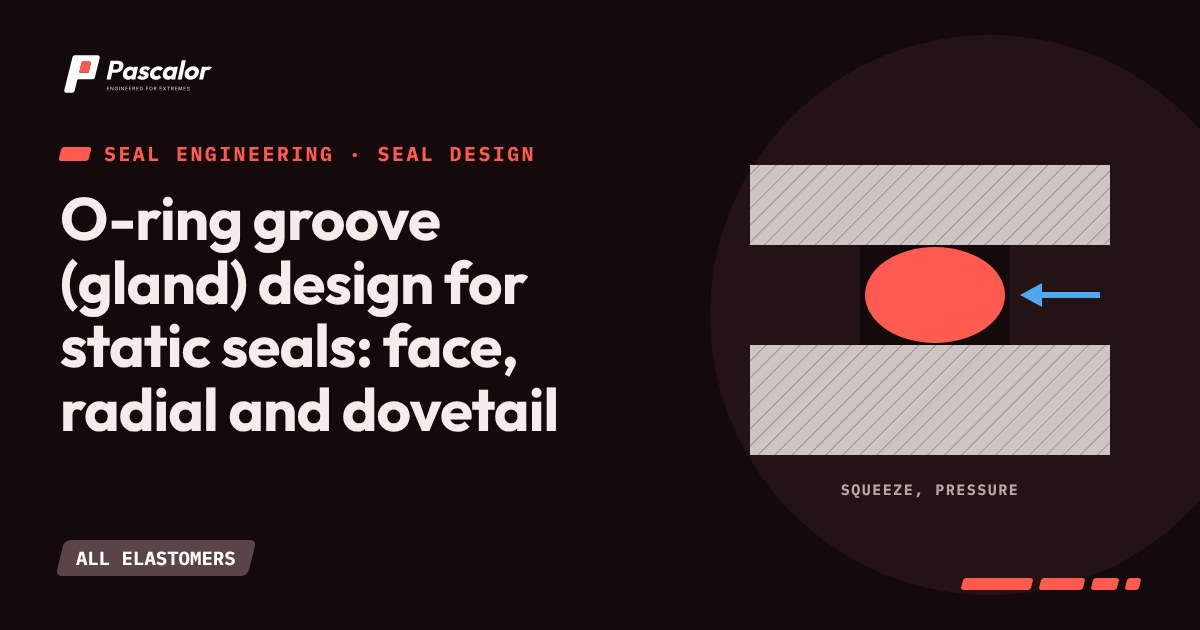
Seal arrangements
- Face seal (axial). Pressure acts inside or outside the ring against a flat face. Used for covers and flanges.
- Radial seal (rod, piston, plug). The ring seals between two cylindrical surfaces.
- Dovetail groove. Holds the ring in place on a face when the cover is opened often or vacuum would pull it out.
Targets for static seals
| Quantity | Typical target |
|---|---|
| Squeeze | 15 to 30 percent of cross section (higher for small sections) |
| Stretch on diameter | 1 to 5 percent, avoid above 5 |
| Groove fill (ring area / groove area) | 60 to 85 percent at maximum material condition, never above about 90 |
| Corner radius in groove | 0.2 to 0.4 mm (so the ring does not cut) |
| Surface finish, sealing faces | about Ra 0.8 micrometres for liquids, finer for gases or vacuum |
These are common design values, not guarantees. Use the ring maker's tables, and check your own tolerance stack.
Worked example (metric)
A face seal needs a 3.53 mm cross-section ring. Target squeeze 20 percent.
- Nominal compressed height: 3.53 x (1 - 0.20) = 2.82 mm. Groove depth about 2.8 mm.
- Ring tolerance on cross-section plus or minus 0.10 mm; groove depth tolerance plus 0.05 mm, flange gap 0.05 mm.
- Minimum squeeze (small ring, deep groove, wide gap): (3.43 - (2.85 + 0.05)) / 3.43 = about 15 percent. Maximum squeeze: (3.63 - (2.80 + 0)) / 3.63 about 23 percent. Fine.
- Groove width: ring area 3.53 squared x pi / 4 = 9.8 mm2. Target fill 75 percent: groove area 13.1 mm2, width = 13.1 / 2.8 = 4.7 mm.
- Check groove fill at maximum ring size and minimum groove: must stay below 90 percent.
Pressure direction
For internal pressure on a face seal, the ring sits against the outer wall of the groove, and for external pressure against the inner wall. Locate the groove so the ring is pushed toward the low-pressure side when pressurised.
Dovetail rules
Angle about 5 degrees on each side, narrower opening than the base, sharp edges relieved. Dovetails are costly to machine, so use them only where retention is needed.
Things people forget
- Thermal differential growth between flange and ring.
- Swell in the fluid (add 10 to 20 percent void).
- Vacuum pulls the ring toward the vacuum side.
- Bolt spacing: flanges bow between bolts and lose squeeze mid-span.
- Bad corners and burrs on the groove edge.
About this article. It is original writing prepared from public sources, standards and general industry practice. It is not a copy of any book or standard and it is not engineering advice. Confirm values against the current edition of the standard and test in your own application. Only analyse material you own or are entitled to analyse.