A compound is not done when it leaves the mixer. It is done when its tests say so.
The minimum set
| Test | What it detects | Typical use |
|---|---|---|
| Mooney viscosity | polymer breakdown, dispersion, moisture | release test and trend |
| Rheometer curve (ML, MH, ts2, t90) | cure system, crosslink potential, scorch | release test, ASTM D5289 or ISO 6502 |
| Density | missing or extra filler, weighing errors | quick gross check |
| Hardness of a cured test piece | cure state and filler level | release test |
| Dispersion rating | undispersed filler | visual or image-based rating |
Dispersion
Cut a fresh surface and examine it under low magnification. Standard approaches rate dispersion on a numerical scale, and some automate the count of agglomerates. Poor dispersion lowers tensile, tear and fatigue life and increases hysteresis.
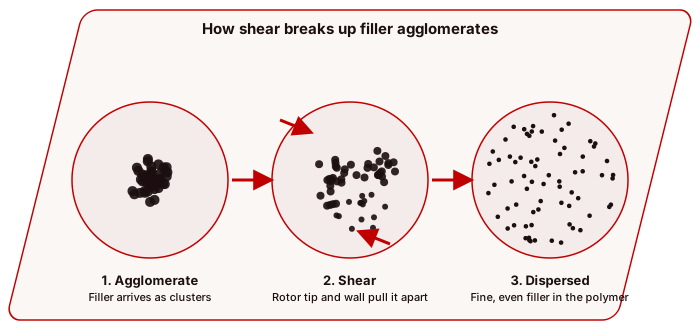 Figure. Filler clusters are pulled apart where the rotor tip passes close to the chamber wall.
The Payne effect
A rubber processing analyser (RPA) measures how the stiffness of an uncured or cured compound changes with strain amplitude. The drop in modulus with increasing strain is the Payne effect, and it reflects the filler network. A change in this curve between two batches with the same recipe is a sensitive sign of change in filler dispersion or filler-polymer interaction.
Charting
For each critical property, chart the individual batch values on a control chart with warning and action limits. Look for:
- Trends: drifting up or down over many batches, often wear or raw-material change.
- Shifts: a step change, often a change in material lot or operator.
- Increased scatter: loss of control.
Responding
- Out of limit: hold the batch, retest, and investigate before the batch is released. Decide whether to rework, blend off or reject.
- Within limit but trending: treat as a warning, because the next batch may fail.
- Record every deviation with date, reason and action, as traceability.
Retain samples
Keep a sample of each batch's rubber and cured test slab for at least the agreed retention period. Many customers require retention for investigation.