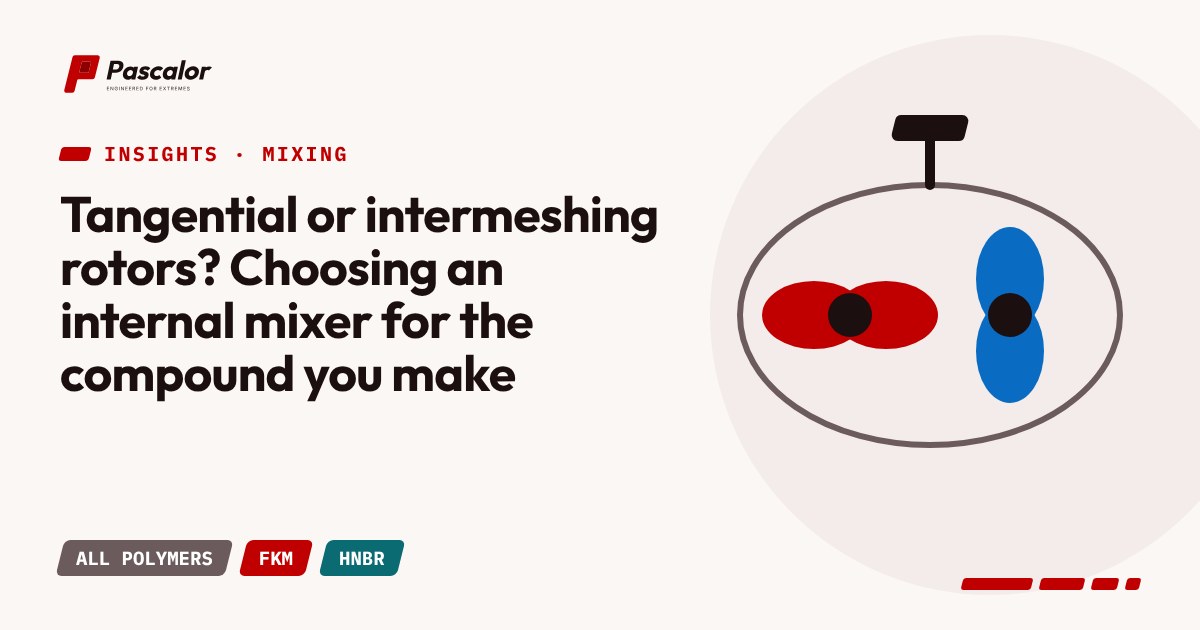
Both machine types are internal mixers. The rotors decide how the rubber moves.
Tangential rotors
The rotors do not overlap, so each rotor sweeps its own half of the chamber, with a clearance between them. Rotor speeds may be equal or different.
Strengths
- Flexible: one machine does masterbatches, remills and finals.
- Friction ratio allowed: running one rotor faster than the other adds shear.
- Larger batch factor in many designs, so higher throughput for general compounds.
Weaknesses
- Temperature rises faster and is harder to control in demanding mixes.
- Mix quality depends more strongly on operator practice and fill.
Intermeshing rotors
The rotors overlap and the wings of one pass between the wings of the other. Rotor speeds are equal.
Strengths
- Strong control of temperature because the rotors themselves are cooled and the cooled surface contacts the batch.
- Good distributive mixing and dispersion, often in shorter cycles.
- Often better batch-to-batch consistency once settings are fixed.
Weaknesses
- Needs a smaller fill and a smaller chamber for the same batch weight.
- Higher mechanical load and more wear on the rotor tips.
- Less flexible: friction ratio is not possible.
What matters for specialty elastomers
| Requirement | Better fit |
|---|---|
| Peroxide compounds with a scorch risk | intermeshing (temperature control) |
| Very stiff FKM or HNBR gum | both, with a low fill factor and cool start |
| Many different compounds in small batches | tangential (flexibility) |
| High silica or very high filler loadings | rotor profile matters more than type |
| Heat-sensitive recipes with plasticisers | intermeshing, or tangential with careful cooling |
Do not forget
Machine condition outweighs machine type. Worn rotor tips, wrong rotor clearance, leaking seals and failing cooling water cause more variation than the difference between families. Make rotor inspection and clearance measurement part of routine maintenance.
About this article. It is original writing prepared from public sources, standards and general industry practice. It is not a copy of any book or standard and it is not engineering advice. Confirm values against the current edition of the standard and test in your own application. Only analyse material you own or are entitled to analyse.