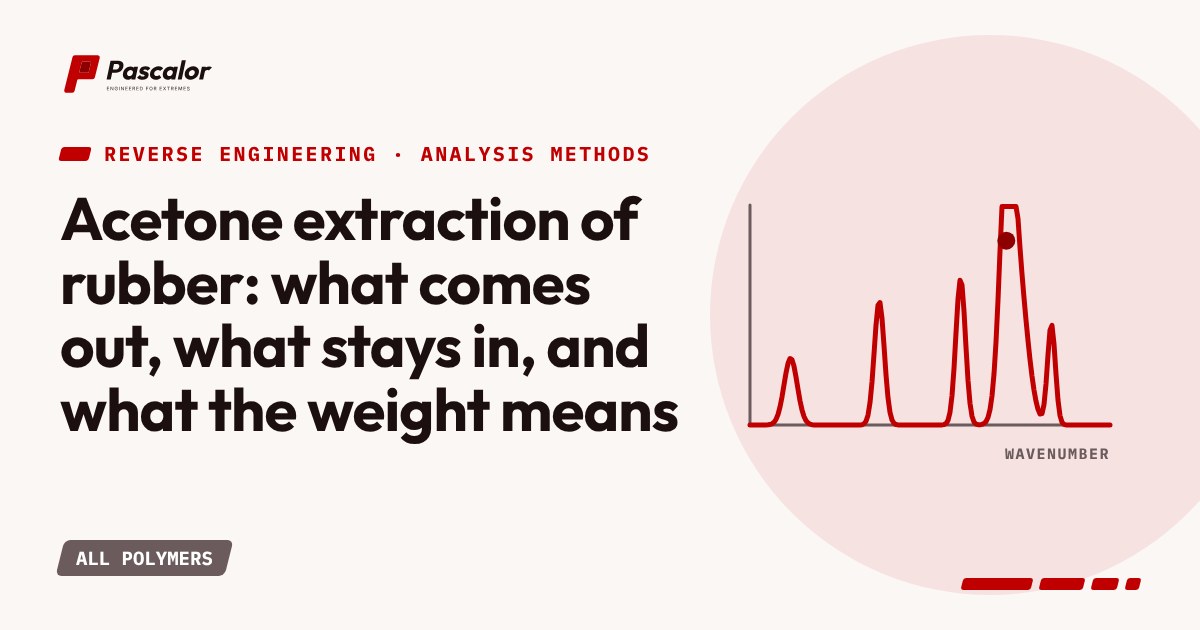
Before anything is burned or scanned, the soluble part of a vulcanised rubber is usually removed with a solvent. The most common choice is acetone, run in a Soxhlet-type apparatus that continuously washes the sample with fresh, condensed solvent for several hours.
What the extract contains
- Process and extender oils, and plasticisers such as esters used to help low-temperature flexibility.
- Waxes and processing aids that give a rubber its surface bloom and release behaviour.
- Antioxidants and antiozonants that were not bound into the network.
- Residual curatives and the by-products of cure, such as sulfur not tied into crosslinks and accelerator fragments.
- Fatty acids such as stearic acid and some resins.
What the extraction leaves behind
The polymer network, carbon black and mineral fillers, metal oxides and anything chemically bonded into the matrix stay in the sample. That residue is the input for thermogravimetry and ash analysis.
How the weight is used
The percentage lost is the acetone extract figure. It is a major input into the reconstruction because it tells you how much non-polymer organic material was in the compound. Be aware of three limitations.
- Acetone is a compromise. It removes polar and mid-polarity materials well but may leave behind high-molecular-weight resins and some heavy oils. Chloroform or another solvent is often used for a second extraction when the first is not complete.
- Some of what you extract was not an ingredient. Absorbed service fluids look like plasticiser. Moisture and volatiles can be counted twice if the sample is not dried.
- Some of what was added is not extractable. Bound antioxidants, zinc salts, coagent residues and polymeric plasticisers may not come out.
Practical tips
- Dry the sample before and after extraction to constant weight, at a temperature that does not drive off the oils you are trying to measure.
- Keep the extract. Evaporate the solvent and analyse the residue by infrared spectroscopy and gas chromatography with mass spectrometry. That is how oils, plasticisers and antioxidants are identified.
- For fluoroelastomers and silicones the extract is usually small. A large extract in an FKM part should make you suspect absorbed fluid or processing aids, not a plasticised recipe.
- Write the solvent, time and drying condition into the report. Another lab will not reproduce your number otherwise.
Sources and further reading
- ASTM D297, rubber products: chemical analysis (extraction sections).
- ISO 1407, rubber: determination of solvent extract.
About this article. It is original writing prepared from public sources, standards and general industry practice. It is not a copy of any book or standard and it is not engineering advice. Confirm values against the current edition of the standard and test in your own application. Only analyse material you own or are entitled to analyse.