Fillers are the largest single block of mass in most compounds after the polymer, and they decide hardness, modulus, tear, abrasion and compression set. Working out the filler system is one of the highest-value parts of any reconstruction.
Step 1: black or not
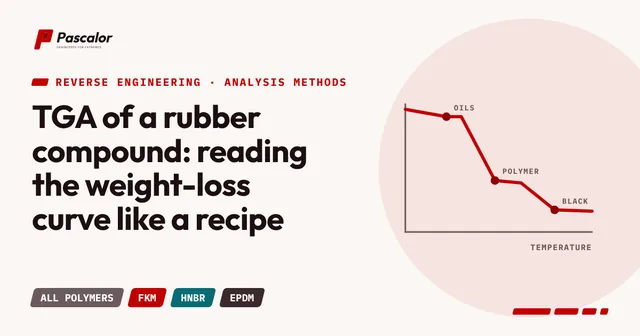
A colour check on a cut surface is only a hint. TGA separates the two: carbon black burns away in air at high temperature, mineral fillers remain as ash. A dark compound with high ash has both.
Step 2: what is in the ash
Dissolve the ash in acid and look at what dissolves and what does not.
- Acid-soluble residue points to zinc oxide, magnesium oxide, calcium oxide, hydroxide or carbonate. Metal analysis by atomic absorption or inductively coupled plasma assigns amounts to each metal.
- Acid-insoluble residue points to silica, silicates, clay and titanium dioxide. Infrared of the residue or X-ray techniques tell these apart.
Step 3: how fine is it
Particle size and structure separate a reinforcing grade from a semi-reinforcing one.
- For black, electron microscopy of the extracted filler gives primary particle size, and a measure such as iodine adsorption or oil absorption (if enough material is isolated) links it to the standard grade families.
- For silica, surface area is the key number, and the presence of a coupling agent shows in the sulfur or silicon balance.
What the filler system tells you about properties
| Filler type | Effect | Common in |
|---|---|---|
| Fine reinforcing black | high tensile, tear, abrasion; higher heat build-up and hardness | dynamic HNBR, hose, tyre |
| Coarse thermal black (large particle) | low hardness rise, low set, good heat ageing, low strength | FKM and FEPM seals, static O-rings |
| Silica with coupling agent | tear, low rolling loss, good dynamic properties | tyres, some HNBR |
| Calcium and magnesium compounds | acid acceptors, cure aids, not only fillers | FKM, ACM, CR |
| Barium sulfate, clay, talc | cheap, non-reinforcing bulk, coloured parts | low-cost seals, rolls |
A caution on fluoroelastomers and HNBR
In FKM the magnesium and calcium compounds in the ash are part of the cure system, not bulk filler. Do not count them twice. In HNBR the zinc oxide and magnesium oxide are usually acid acceptors and cure aids too. Always ask what a metal is doing before deciding how much "filler" there is.
What to match in the trial mix
Match the filler type and level first. Then check hardness, modulus at 100%, compression set and density against the original. If hardness is right but modulus is low, the filler is probably too coarse. If compression set is worse, look at black structure and cure first.