

Reverse engineering library
Reverse engineering of rubber
How a finished rubber part is analysed, how the numbers become a recipe, and where the method stops. Original articles for compounders, quality engineers and buyers.
What reverse engineering cannot find: five blind spots in every rubber analysis
Honest limits of compound analysis: curatives, supplier grades, mixing history, trace additives and cure state. Why a reconstruction is a starting point and not a copy.
Read →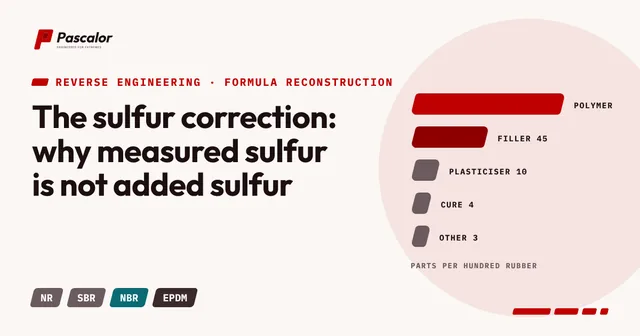
The sulfur correction: why measured sulfur is not added sulfur
Total sulfur from an elemental analyser includes sulfur from donors, accelerators and the filler. How to correct it before reporting a sulfur phr, and when not to bother.
Read →
The physical profile of a rubber part: which tests to run and what each one hints at
Chemistry gives a recipe. The physical profile tells you whether the recipe behaves. A practical list of tests, standards and the clues each one gives about composition.
Read →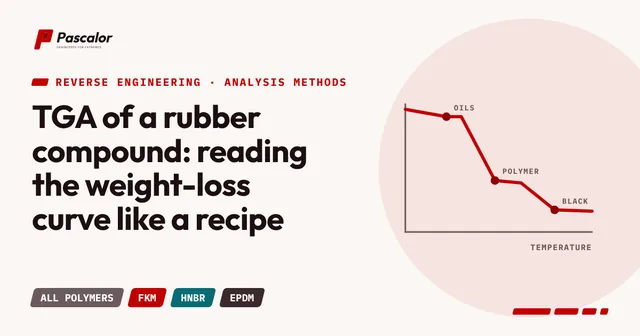
TGA of a rubber compound: reading the weight-loss curve like a recipe
Thermogravimetric analysis splits a cured compound into volatiles, polymer, carbon black and ash. How the test runs, how to read the steps and what can mislead you.
Read →
Sample preparation for rubber analysis: how to avoid ruining the answer before you start
Most bad reverse engineering results are sample problems. How to choose, clean, cut and homogenise a rubber sample so that every later number can be trusted.
Read →
Reverse engineering silicone rubber (VMQ): why it is different and how to analyse it
Silicone behaves very differently from organic rubbers during analysis. A guide to identification, filler measurement, cure type and the cold-temperature advantage that makes it relevant to HPLT.
Read →
Reverse engineering a rubber part: the ten-step map from sample to recipe
A one-page map of how a cured rubber part is turned into an estimated formulation, with what each step tells you and where each one can mislead you.
Read →
Reverse engineering a fluoroelastomer (FKM) part: what works, what is hazardous, what stays unknown
A practical guide to analysing FKM O-rings and seals: fluorine content, cure system, acid acceptors, safety with hydrogen fluoride, and how to match low-temperature behaviour.
Read →
Reverse engineering HNBR: acrylonitrile content, hydrogenation level and peroxide cure
How to establish what kind of HNBR a part is made from, how to read acrylonitrile and residual unsaturation, and why cure and filler matter as much as the polymer.
Read →
Reverse engineering FEPM (Aflas-type) parts: steam, bases and the fingerprints that identify them
FEPM is a TFE-propylene copolymer that looks like FKM on some tests and is not. How to tell them apart, and what to match for steam and amine duty.
Read →
Reverse engineering EPDM: ethylene content, diene type, oil extension and peroxide or sulfur cure
EPDM is the commonest seal rubber for water, steam and weather. How to establish its ethylene-propylene ratio, diene, extension oil and cure system from a cured part.
Read →
Pyrolysis for crosslinked rubber: identifying polymers that will not dissolve
How pyrolysis-IR and pyrolysis gas chromatography break a vulcanised network into recognisable fragments, and what to watch for with halogenated and silicone polymers.
Read →
Microscopy in rubber analysis: particle size, structure and dispersion quality
Optical, scanning and transmission electron microscopy reveal filler type, particle size and dispersion. What each method shows and how it feeds a reconstruction.
Read →
Is reverse engineering rubber allowed? Practical rules for staying on the right side of the line
Not legal advice. A plain-language overview of when analysing a rubber part is routine and when contracts, patents or trade secrets can limit it, and how to protect yourself and your customer.
Read →
Identifying the polymer in a cured rubber by infrared spectroscopy
Which bands in an FTIR spectrum point to which elastomer, how ATR and pyrolysis sampling differ, and why filled, cured rubber spectra need care.
Read →
How to read a reverse engineering report, and what a good one must contain
A buyer's guide to compound analysis reports: scope, methods, results with units, confidence statements and the limitations section that tells you how far to trust it.
Read →
Hardness, density and modulus as clues: guessing the filler system before the lab results arrive
A bench-top approach to reading a rubber. Three quick measurements already narrow the polymer family, the filler level and the likely cure, and make later analysis faster.
Read →
HPLC and TLC for rubber additives: antioxidants, accelerators and what survives cure
Liquid chromatography and thin-layer chromatography handle the additives that GC cannot. What they find, what they cannot, and why accelerators are the hardest ingredient.
Read →
GC-MS of rubber extracts: finding the oils, plasticisers and antioxidants
How gas chromatography with mass spectrometry identifies what a solvent extract contains, what it cannot see, and how to turn peak areas into estimated loadings.
Read →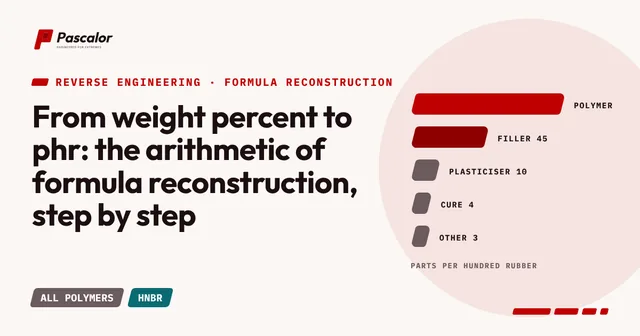
From weight percent to phr: the arithmetic of formula reconstruction, step by step
A fully worked example showing how TGA, ash and extraction results become a recipe in parts per hundred of rubber, with the checks that catch mistakes.
Read →
Five good reasons to reverse engineer a rubber part, and two bad ones
Second sourcing, failure analysis, benchmarking, obsolescence and documenting legacy parts all justify analysis. Cloning a competitor to claim its approvals does not.
Read →
Elemental analysis in rubber: sulfur, fluorine, chlorine and what each one tells you
Which elements to measure in a vulcanised rubber, how they are measured, and how the numbers narrow down the polymer and cure system.
Read →
DSC and the glass transition: a polymer fingerprint that also predicts cold performance
Differential scanning calorimetry finds the glass transition temperature of a rubber. It supports polymer identification and is the single most useful number for HPLT duty.
Read →
Crosslink density by swelling: the Flory-Rehner estimate and its pitfalls
How equilibrium swelling in a solvent gives an estimate of network density, what filler does to the result, and why it should be used for comparison rather than as an absolute number.
Read →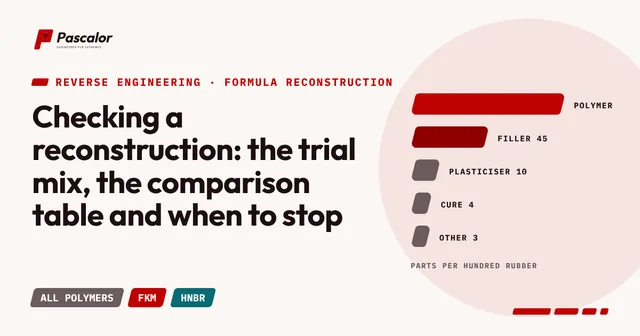
Checking a reconstruction: the trial mix, the comparison table and when to stop
A reconstruction is a hypothesis. How to test it with a small trial mix, which properties to compare, how close is close enough, and how many iterations to expect.
Read →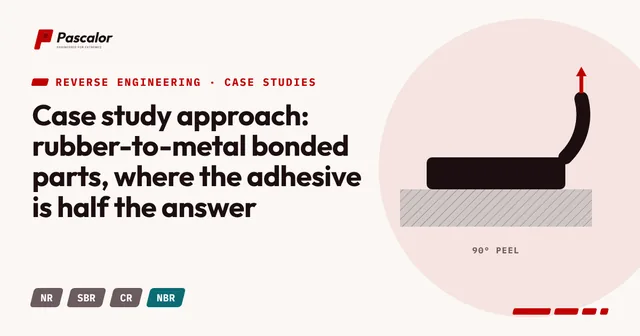
Case study approach: rubber-to-metal bonded parts, where the adhesive is half the answer
Bonded bushes, mounts and rings add metal, primer and adhesive to the analysis. How to isolate the rubber, what to test at the bond, and what is outside what analysis can reveal.
Read →
Case study approach: reconstructing a passenger-car tyre tread compound
How the tread cap is separated, which polymer blend is expected, why silica and black appear together, and what a reconstruction table looks like. A method walk-through, not a recipe.
Read →
Case study approach: a rubber seal. The checklist from first look to trial mix
Seals are small and valuable. A step-by-step checklist for analysing an O-ring or moulded seal when there is not much sample and the duty is demanding.
Read →
Case study approach: a heat-resistant conveyor belt cover compound
A conveyor belt that carries hot material needs a cover rubber that survives heat. How analysis separates cover from carcass and finds the polymer system, antidegradants and the cure type.
Read →
Case study approach: a halobutyl inner liner, and why air retention changes everything
Inner liners hold air. How analysis distinguishes bromobutyl, chlorobutyl and regular butyl, and what the filler and resin system adds to air permeability.
Read →
Case study approach: a fuel hose cover and the NBR/PVC blend
Fuel hose covers must resist ozone, heat and fuel splash. How analysis finds the NBR/PVC blend ratio, the plasticiser and the stabiliser system, using chlorine and nitrogen as keys.
Read →
Carbon black or mineral filler? How to tell, and why the answer drives the property profile
Black or white, fine or coarse, reinforcing or semi-reinforcing: how analysis separates the filler system and what that tells you about hardness, strength and set.
Read →
Blend ratios by infrared: how NR, SBR and BR proportions are estimated
Many rubber parts are blends. How band intensity ratios, calibration blends and thermal data combine to estimate proportions, and how wide the error bars really are.
Read →
Ash analysis and acid digestion: what the residue says about fillers and cure aids
How burning a rubber sample and dissolving the ash in acid separates zinc oxide, magnesium and calcium compounds from silica, clay and titanium dioxide.
Read →
Acetone extraction of rubber: what comes out, what stays in, and what the weight means
Solvent extraction is the first quantitative step in compound analysis. Here is what it removes, how the numbers are used and why the result is only an estimate.
Read →
AAS and ICP for rubber: counting zinc, calcium, magnesium and the rest
Atomic absorption and plasma emission turn dissolved ash into amounts of each metal. How the methods differ, how they are calibrated and how results convert to ingredient loadings.
Read →Nothing matches that search.